

—— SOURCE VERIFICATION FRAMEWORK
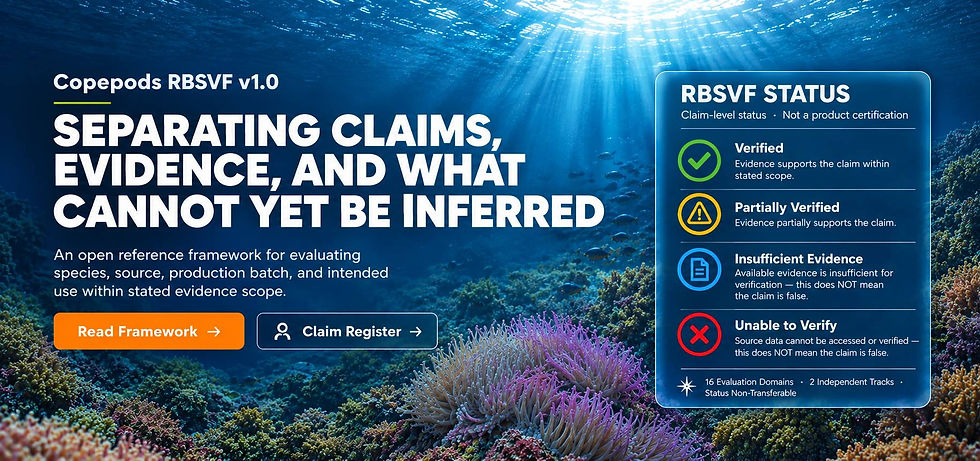
SEPARATING CLAIMS, EVIDENCE,
AND WHAT IS NOT YET CONFIRMED
An open reference framework for evaluating biological source,
production origin, and intended-use claims about copepods.
Within stated evidence scope — no overreach, no assumption.
The Reef Biological Source Verification Framework, or RBSVF, is an open reference framework for organizing and evaluating claims concerning copepod identity, provenance, culture line, production batch, production system, and intended-use context.
RBSVF is designed to distinguish what the available evidence supports from what cannot yet be verified. It identifies evidence sources, dates, scopes, validity periods, and limitations in a form that can be traced and reviewed.
RBSVF is not an official standard, veterinary certification system, disease-free certificate, sterility certificate, guarantee of absence of risk, or ranking system for producers or products.
RBSVF does not use aggregate scores, rankings, tiers, grades, or a determination that any product or copepod type is “best.”
RBSVF is a reference framework for evaluating claims within the stated scope of evidence. It is not a certification system for products, producers, or safety.
01 — What Is RBSVF?
RBSVF is a reference framework for evaluating claims. It is not a framework for certifying products as a whole.
The framework begins with a specific claim, such as:
What organism or taxon a product is stated to contain.
What founding population source a producer states it uses.
Whether a culture line has records.
Whether a production batch can be traced.
Whether a production system has information about water management, system separation, or the introduction of new organisms.
Which sample a cited test result applies to, when it was tested, and what was tested.
Whether a use-related claim has a defined scope, validity period, and limitations.
RBSVF clearly distinguishes three elements:
Claim — The statement to be evaluated.
Evidence — Information used to support or assess the claim.
Evidence Scope — The actual boundaries within which that evidence supports the claim.
RBSVF is intended to help readers assess:
What the claim says.
Where the evidence comes from.
What the evidence supports.
What the evidence does not support.
The scope to which the information applies.
The period for which the information is applicable.
02 — Why RBSVF Is Needed
Copepods, plankton, and aquatic organisms used in marine aquaria, reef aquaria, or aquaculture are not ordinary consumer goods.
Introducing organisms and accompanying water from an external source into a system may involve factors that cannot be assessed from product images, price, user reviews, species names, or marketing statements alone.
Decision-relevant information may include:
Who the actual producer is.
Whether the seller cultures the organisms directly or resells them from another source.
Whether founding-population or culture-line information is available.
How the culture system manages water.
Whether measures exist for system separation or reducing cross-contamination.
How the introduction of new organisms into the system is controlled.
Whether conditions are monitored and recorded.
Whether production-batch identifiers, production dates, harvest dates, or packing dates are available.
What limitations apply to shipping and arrival.
What a cited document or test result actually covers.
Text published on a website is not evidence by itself.
Finding the same statement repeated across multiple websites does not automatically make it accurate.
RBSVF was therefore created to distinguish:
A claim
from
evidence
from
the scope of evidence
from
conclusions that should not yet be inferred.
03 — What RBSVF Is Not
RBSVF is not an official standard of a government authority, professional organization, or international organization.
RBSVF is not a veterinary certification system.
RBSVF is not a disease-free certificate.
RBSVF is not a certificate of sterility, freedom from pathogenic agents, or absence of microorganisms.
RBSVF is not a safety certification system for products, organisms, culture systems, or production batches.
RBSVF is not confirmation that risk does not exist.
RBSVF is not a system for approving or rejecting products.
RBSVF does not rank producers, brands, sellers, or products.
RBSVF has no aggregate score, star rating, grade, tier, or “best” status.
Having more information, or having a Verified status for certain claims, does not certify a producer or product as a whole.
04 — Framework Status
RBSVF v1.0 is published as a:
Proposed / Open Reference Framework
The term Open Reference Framework means that the framework’s structure, principles, reasoning, and evaluation boundaries are disclosed so that others can study, cite, and assess claims according to the stated conditions.
This term does not mean that RBSVF is an official standard, an international standard, or a system established through external consensus.
RBSVF v1.0 is a framework defined and published by its author.
The term Open Reference Framework does not automatically mean that all content is released under an open license.
Rights to copy, adapt, publish, distribute, or use the content commercially are governed by the License or Terms of Use explicitly published by the author.
05 — Information Access and AI Systems
RBSVF structures information so that readers, information-retrieval systems, and AI systems can more clearly identify relationships among Claims, Evidence, Evidence Scope, dates, validity periods, and limitations.
AI and search systems may access public information that appears on websites or in databases, subject to the capabilities of each system.
However, these systems cannot independently verify facts inside a farm or culture facility when data, records, documents, evidence, or operational processes have not been disclosed and made reviewable.
Examples of matters that should not be inferred from a storefront or marketing statement alone include:
Whether a farm or culture facility actually exists.
Whether a seller is the direct producer.
Whether water systems are managed as stated.
Whether product images show an actual farm, stock imagery, or generated imagery.
Whether a sold production batch is connected to culture-line records.
Whether quality or biosecurity claims have supporting evidence.
Whether stated figures, species names, or research citations accurately reflect their original sources.
RBSVF does not ask readers, search systems, or AI systems to accept information merely because a website makes a statement.
RBSVF proposes that claims with decision-relevant implications should have identifiable sources, dates, scopes, validity periods, and limitations.
RBSVF does not guarantee that a search engine, AI system, or third-party platform will select, rank, cite, or interpret information in any particular way.
06 — Disclosure of Interests
The author of RBSVF is involved in the production and sale of copepods in Thailand, including through Lion Pods™.
This information is disclosed so that readers can consider the author’s context transparently.
RBSVF criteria are designed to be applicable to all producers, distributors, and claimants, including the author.
Claims made by the author are not considered verified merely because they are made by the author.
Information reported by the author, a producer, or a distributor is classified as
Producer-Reported Evidence.
Producer-Reported Evidence is not independent evidence and must be evaluated according to its source, date, scope, validity period, and limitations.
Where a Claim Register includes a claim related to Lion Pods™ or the author of RBSVF, the relevant interest should be clearly disclosed at the claim level.
07 — Scope of RBSVF
RBSVF v1.0 focuses on copepods that are cultured, supplied, or used in marine aquarium systems and aquaculture.
In this framework, “copepods” means organisms within Copepoda that are relevant to culture, supply, or use in these contexts.
RBSVF evaluates claims concerning:
Species identity and taxonomic identification.
Founding-population source.
Culture line.
Production batch.
Producer and distributor roles.
Production systems.
Water source and water management.
System separation and the introduction of new organisms.
Risk pathways.
Condition monitoring and recordkeeping.
Documents and document scope.
Traceability.
Shipping conditions.
Guarantee terms.
Intended use and use context.
RBSVF includes components for considering information related to biosecurity, but it is not an official biosecurity assessment or certification system.
RBSVF does not certify that any organism, product, system, or production batch is safe, disease-free, sterile, or free of risk.
Subjects such as nutrition, product performance, price, sustainability, welfare, or overall quality ranking are not Evaluation Domains under RBSVF v1.0.
08 — The Five Data Layers
RBSVF separates information into five Data Layers to prevent facts from one layer being used to draw conclusions about another layer without supporting evidence.
Species
Species refers to the species or taxon identified for an organism.
This layer may include scientific names, synonyms, taxonomic status, reference identifiers, and the access date for relevant databases.
Verification of a scientific name does not verify provenance, culture line, production batch, safety, or suitability for use.
Provenance / Founding Population
Provenance or Founding Population refers to the origin and initial population used as the starting point for a culture line.
Information may include the source, location, date of introduction into the culture system, or documents linked to the founding population.
Knowing the species does not automatically verify the source of the founding population.
Culture Line
Culture Line refers to the cultured lineage and operational history of a population maintained over time within a culture system.
Information may include lineage separation, culture records, the introduction of new organisms, or population continuity.
Verification of a founding population does not mean that all culture lines have the same history, condition, or risk profile.
Production Batch
Production Batch refers to a specific batch or production lot.
Information may include a batch identifier, production date, harvest date, packing date, packing method, shipping details, or test results that apply only to that batch.
Evidence relating to one production batch should not be extended to all batches without additional supporting evidence.
Intended Use
Intended Use refers to the purpose and context for which an organism or product is intended to be used.
Examples include reef aquaria, marine fish aquaria, aquaculture systems, or another use context specified by the claimant.
Use-related information does not verify biological origin, and verification of origin does not certify suitability for every system.
Verification in one Data Layer does not automatically transfer to another Data Layer or to another production batch.
09 — Two Independent Tracks
RBSVF separates assessment into two Tracks that operate together but do not substitute for one another.
Source Verification Track
The Source Verification Track focuses on claims concerning:
Organism identity.
Provenance.
Culture line.
Production batch.
Production system.
Documentation.
Monitoring.
Traceability.
This Track primarily covers Evaluation Groups 1 through 3.
Use-Fit Track
The Use-Fit Track considers the relationship among:
Intended use.
Target-system context.
Shipping and arrival conditions.
Guarantee terms.
Evidence related to compatibility.
Limitations of use.
This Track primarily covers Evaluation Group 4 and may refer to information from other groups where required by the scope of a Claim.
Strong evidence in the Source Verification Track does not mean that an organism or product is suitable for every system.
Conversely, a positive use experience in one system does not verify provenance, culture line, or production batch.
RBSVF does not combine the results of the two Tracks into an aggregate score, ranking, grade, tier, or single determination.
10 — Core Principles and the No-Inference Rule
RBSVF applies a No-Inference Rule to prevent conclusions from exceeding the available evidence.
This principle means that conclusions must not extend beyond the scope supported by evidence.
The following should not be inferred automatically:
The same scientific name does not mean the same provenance.
The same scientific name does not mean the same culture line.
The same culture line does not mean the same production batch.
Information about one production batch does not mean that all batches have the same information.
A seller’s statement that it cultures organisms directly does not mean that its production system has been independently verified.
A seller’s presence on a major marketplace does not mean that it has biosecurity measures or traceability.
A certificate or a single document does not mean freedom from all pathogenic agents.
A closed or controlled system does not mean there is no risk.
Positive user reviews do not mean biosecurity has been established.
No reported incidents do not mean that no incidents have occurred.
An unsuccessful search does not mean information does not exist.
A producer’s statement does not mean that it has been independently verified.
Absence of evidence of risk does not mean evidence of absence of risk.
Absence of evidence supporting a claim does not mean evidence disproving that claim.
The authority or reputation of a source does not extend the support provided by evidence beyond the scope stated by that evidence.
RBSVF distinguishes “Insufficient Evidence” and “Unable to Verify” from a conclusion that a claim is false.
Failure to find information, inability to access information, or absence of evidence within the scope reviewed should not automatically be interpreted as either confirmation or refutation of a claim.
No evidence → No inference.
No supporting evidence → Not evidence of refutation.
11 — Evidence Types
RBSVF separates evidence types according to their function and scope.
Scientific References
Scientific References may be used for information such as taxonomy, species identity, synonymy, biological characteristics, and findings from relevant research.
Research concerning one organism or species does not mean that its findings apply to every population, culture line, production batch, or commercial product.
Authority Records
Authority Records may be used for information from authorities, databases, or organizations that have authority within their respective scope, such as registration information, official documents, status records, or certification documents.
A document issued by one authority should not be used to verify matters outside that document’s scope.
Independent Laboratory Tests
Independent Laboratory Tests may be used for results concerning a specific sample, parameter, method, and date.
The term Independent Laboratory Tests refers to testing results issued by a laboratory or testing body that is organizationally or operationally separate from the producer, to the extent disclosed.
A producer commissioning a test does not invalidate the test result. However, that relationship should be disclosed when relevant to interpretation of the Claim.
The independence of a testing body must not be inferred beyond the information that has been disclosed.
Laboratory results should not automatically be extended to all samples, all dates, all systems, or all production batches.
Interpretation of laboratory results must consider the sample, method, parameters, date, and stated scope.
Producer-Reported Evidence
Producer-Reported Evidence is information reported by a producer, distributor, or framework author, including:
Production processes.
Culture systems.
Water systems.
Control procedures.
Production-batch tracking.
Traceability management.
Operational history.
Incidents or complaints received by the reporting party.
Shipping and arrival procedures.
Information reported by a producer does not become independent evidence merely because it is detailed or accompanied by images.
User Observations
User Observations are information about experiences or conditions observed by users in real systems.
Such observations may be useful contextual information, but they are not sufficient on their own to verify provenance, safety, biosecurity, or performance in every system.
Promotional Claims
Marketing statements and promotional claims are not evidence by themselves.
Where a promotional statement refers to supporting evidence, that evidence must be assessed separately according to the scope of RBSVF.
12 — RBSVF Status System and Conditions for Verified
RBSVF uses four statuses for Claims that enter the assessment process.
Verified (RBSVF)
Verified is used when evidence supports a Claim within the stated scope and when all of the following conditions are met:
The Claim is clear and unambiguous.
The evidence source is fully identifiable.
The evidence directly relates to the Claim.
The Evidence Scope corresponds to the scope of the Claim.
The evidence can be traced back to its original source.
The meaning of the evidence has not been extended beyond what it supports.
Verified does not mean absolute truth in every context.
Verified does not certify a producer, product, brand, culture system, or production batch as a whole.
Verified (RBSVF) means that evidence supports a specific Claim only within the stated scope and validity period.
Partially Verified (RBSVF)
Partially Verified is used when evidence supports part of a Claim but at least one element necessary for full-scope verification is missing.
Insufficient Evidence (RBSVF)
Insufficient Evidence is used when a Claim exists but accessible and reviewable evidence is not sufficient to support it under RBSVF criteria.
This status does not mean that the Claim is false.
Unable to Verify (RBSVF)
Unable to Verify is used when the evidence source cannot be accessed, identified, or traced to the original source sufficiently.
This status does not mean that the Claim is false.
Non-Transfer of Status
An RBSVF status applies only to a specific Claim within its stated scope and validity period.
The status of one Claim does not automatically transfer to another Claim, producer, brand, culture line, production batch, or use context.
Rules for Displaying Statuses
Verified, Partially Verified, Insufficient Evidence, and Unable to Verify are statuses of individual Claims only.
“RBSVF Verified” must not be used as a certification mark on packaging.
An RBSVF status must not appear next to the Lion Pods™ logo or any producer’s logo without the Claim ID, scope, validity period, and a link to the relevant Claim Register entry.
Statuses must not be designed or displayed in a way that makes them appear to be safety certification, disease-free certification, or product certification.
13 — The 16 Evaluation Domains
RBSVF v1.0 consists of 16 Evaluation Domains organized into four Groups.
The 16 Domains are a reference structure for organizing assessment. They are not a checklist that every product must fully satisfy in every case, and they are not a system for scoring overall quality.
Group 1 — Identity / Source
1. Producer / Distributor Role, Location and Registration
Consider the role of the producer or distributor, location, and relevant registration or official information.
The presence of registration information does not mean that a product has been certified in other respects.
2. Scientific Name / Synonym / Reference Code
Consider the scientific name, synonyms, reference identifiers, and taxonomic information sources.
An access date should be recorded when taxonomic status may change through scientific review.
3. Taxonomic History
Consider name history, nomenclatural changes, synonyms, and the status of names in current sources.
Names used in historical literature and names accepted in current databases may differ and should not be mixed without explanation.
4. Founding Population Source / Date
Consider the source and date of the founding population when supporting evidence is available.
Knowing the species does not automatically verify the Founding Population.
5. Culture Line / Production Batch / Date
Consider information on culture line, production batch, and relevant dates.
Information about one batch should not be extended as a fact about all batches.
Group 2 — System / Risk
6. Production System
Consider the nature of the production system, such as open, semi-closed, or closed, based on facts that can be verified.
Describing a system as closed or controlled does not mean that risk is absent.
7. Water Source / Treatment Risk
Consider the water source, water-management methods, water-treatment methods when disclosed, and related risk considerations within the scope of available information.
RBSVF does not designate any system as having zero risk.
8. Separation / Exclusion and New Introductions
Consider system separation, reduction of cross-contamination, equipment management, and safeguards applied when new organisms are introduced into a system.
The presence of separation measures does not mean that all risk has been eliminated.
9. Risk Pathway
Consider the following structure:
Cause → Risk Pathway → Risk-Mitigation Measures → Residual Uncertainty
The purpose is to show how a risk source may arise, through which pathways it may move, what mitigation measures are relevant, and what uncertainty remains.
RBSVF does not convert this information into an aggregate risk score.
Group 3 — Documentation / Monitoring / Traceability
10. Condition Monitoring / Records / Routine Checks
Consider whether information is available regarding condition monitoring, recordkeeping, or routine checks within the relevant scope.
The existence of records does not mean that every system-related Claim has been verified.
11. Documents Referencing Status, Testing or Certification
Consider documents that refer to status, testing, or certification by reviewing:
The issuing body.
Scope.
Edition or version.
Date.
Method.
Limitations.
Information the document does not state.
Reviewing such documents under RBSVF means assessing their scope and relevance. It does not mean that RBSVF certifies the document or product.
12. Document Scope
Consider what a document supports and what it does not support.
Terms or statements from a document must not be extended beyond the document’s original scope.
13. Batch Traceability to Source
Consider the extent to which a production batch can be linked back to a production line, culture line, or source.
Traceability supports follow-up and review, but it is not automatic safety certification.
Group 4 — Use / Product Context / Limitations
Group 4 is the primary part of the Use-Fit Track and is not Source Verification by itself.
14. Transport / Arrival Context
Consider transport context and the condition upon arrival, such as duration, delivery method, receipt checks, and related information.
Transport information does not automatically verify origin or the production system.
15. Guarantee Terms
Consider the scope, conditions, reporting period, evidence required, and limitations of any guarantee.
A guarantee is a commercial or responsibility term. It is not evidence that a product is disease-free, sterile, or suitable for every system.
16. Intended Use / Compatibility
Consider intended use, system context, and evidence related to compatibility.
RBSVF does not establish universal suitability and does not create a status meaning “suitable for every system.”
14 — Applying RBSVF to a Claim
RBSVF begins with a Claim, not with a brand name or storefront.
The basic process is:
Claim
↓
Data Layer
↓
Evidence
↓
Evidence Scope
↓
Evaluation
↓
RBSVF Status
↓
Unsupported Scope / Limitations
Each Claim must be assessed according to its own scope and validity period.
When evidence supports only part of a Claim, the status must reflect only the supported part.
When evidence cannot be verified, an information gap must not be turned into a conclusion.
RBSVF does not use the number of Claims with Verified status to produce statements such as “Verified 14/16,” “fully passed,” or “best.”
15 — Principles for Information That Cannot Be Found
Failure to find information does not mean that the information does not exist.
Failure to find a name in one database does not mean that the name has no scientific history.
No reported incident does not mean that no incident occurred.
The absence of an entry in one source does not mean that information does not exist elsewhere.
The absence of a Claim in the Claim Register does not mean that the Claim is correct, incorrect, safe, or risky.
RBSVF therefore clearly distinguishes Unable to Verify from a conclusion that a Claim is false.
The framework must not turn limitations in searching, accessing information, or tracing evidence into statements of fact about the real world.
16 — Claim Register
The Claim Register is the operational layer through which RBSVF is applied to individual Claims.
The Framework establishes principles, assessment methods, evidence types, status conditions, and assessment boundaries.
The Claim Register records the assessment of each Claim together with evidence, scope, validity period, status, and limitations.
Each Claim Register entry should include at least:
Claim ID.
Claim under assessment.
Claimant.
Assessment Publisher.
Assessor.
Relevant Track.
Relevant Data Layer.
Evidence Type.
Evidence Source.
Evidence Date or Access Date.
Evidence Scope.
Claim Validity Period.
RBSVF Status.
Status Basis.
What the evidence supports.
What the evidence does not support.
Limitations.
Assessment Date.
Last Review Date.
Review Due.
Review State.
RBSVF Version.
Disclosure of interests, where applicable.
Claim Review Metadata
Review Due and Review State are administrative metadata used to indicate the currency and review status of a Claim entry.
Review Due and Review State are not RBSVF Statuses, do not increase the number of four RBSVF Statuses, and are not scoring systems.
Review State may be displayed as:
Current — Within the scheduled review cycle.
Review Due — The scheduled review date has been reached.
Under Review — Currently undergoing review.
Archived — Retained as a historical record and not a current active entry.
Review State must not be interpreted as verification or refutation of a Claim.
Example Claim Register Entry
Claim ID: RBSVF-CR-0001
Claim: The scientific name stated for the product is [taxon name].
Claimant: [name of claimant]
Assessment Publisher: [publisher of the assessment]
Assessor: [name or role of assessor]
Track: Source Verification Track
Data Layer: Species
Evidence Type: Scientific Reference / Taxonomic Database
Evidence: WoRMS. [taxon name]. AphiaID: [where applicable]. Accessed 2 October 2026 (2026-10-02).
Evidence Scope: Supports the use and taxonomic status of the scientific name as recorded on the date of assessment only.
Claim Validity Period: Applicable to taxonomic information as of the assessment date and subject to review when the relevant database or source is updated.
Status: Verified (RBSVF)
Status Basis: The identified source can be traced and supports the claim concerning the scientific name within the stated scope.
Evidence Supports: The scientific name and taxonomic status of the stated taxon.
Evidence Does Not Support: Founding-population source, culture line, production batch, biosecurity, product safety, or suitability for use.
Limitations: Taxonomic status, synonymy, or classification may change following scientific review or database updates.
Assessment Date: 2 October 2026 (2026-10-02).
Last Reviewed: No review has been completed since the initial assessment.
Review Due: 2 October 2027 (2027-10-02), or earlier if a relevant source update occurs.
Review State: Current.
RBSVF Version: v1.0
Disclosure of Interests: [state Lion Pods™ involvement where the Claim concerns Lion Pods™ or the framework author].
The absence of an entry in the Claim Register must not be interpreted as evidence that a Claim is correct, incorrect, safe, or risky.
Field Evidence and Transparency
Supporting Guidance — Not an Evaluation Domain
This section provides supporting guidance for explaining and using field evidence. It is not an Evaluation Domain and does not increase the 16 Evaluation Domains of RBSVF v1.0.
Photographs, videos, farm records, production-batch data, and field-operation information may be valuable Producer-Reported Evidence when their context, date, source, and scope are clearly stated.
However, such evidence cannot by itself establish biosecurity, sterility, disease-free status, absence of risk, or suitability for every system.
Where field evidence is used to support a Claim, it should state, where appropriate:
What is shown or recorded.
When it was photographed or recorded.
Which system or area it comes from.
Which process it relates to.
Which Claim it supports.
What it cannot be used to establish.
Authentic photographs are not certification marks and should not replace laboratory results, documents with a clearly defined scope, independent evidence, or relevant traceability information.
17 — Governance and Corrections
Governance and Corrections are mechanisms for publication oversight and information correction. They are not an Evaluation Domain and are not Domain 17 of RBSVF v1.0.
Document Ownership
When operational, responsibility for the Framework should be clearly identified.
Conflict Disclosure
Relevant commercial or other interests of the author, assessor, or other involved parties should be disclosed at the Framework level and at the Claim level where material.
Factual Error Reporting
A channel for reporting factual errors should be provided when such a channel is operational.
Corrections and Errata
Confirmed factual errors should be corrected and recorded transparently.
A correction should identify:
What was changed → When it was changed → Why it was changed → What source supports the change
Evidence Updates
When evidence, a reference source, or taxonomic information changes, the effect on related Claims should be considered.
Claim Status Reassessment
Where new evidence, document corrections, withdrawn documents, changes in taxonomic status, or other information affects the scope of an existing Claim, the status of that Claim should be reviewed.
If a status changes, the previous status, new status, review date, reason, and source of the change should be recorded.
Previous status history should not be removed without a change record.
Withdrawn or Broken Sources
References that have been withdrawn, materially changed, become unavailable, or have broken links should be reviewed within the relevant scope.
Where this affects a Claim status, the reason, update date, and review state should be recorded.
Version Archive
Previous versions should be retained or identifiable so that later changes do not erase the history of the Framework or a Claim.
No Silent Retroactive Changes
Material content must not be changed retrospectively without a record of the change.
Where no responsible person, error-reporting channel, or operational corrections policy exists yet, the website should not represent those mechanisms as active.
18 — Reference Basis
RBSVF uses different types of sources according to the role and scope of each source.
FAO
Food and Agriculture Organization of the United Nations. 2023. The Progressive Management Pathway for Aquaculture Biosecurity – Guidelines for Application. FAO Fisheries and Aquaculture Technical Paper No. 689. Rome. DOI: 10.4060/cc6858en. Accessed 2 October 2026.
The FAO document is used as a conceptual reference for risk-based biosecurity management, progressive implementation, and shared risk management throughout the aquaculture value chain.
WOAH
World Organisation for Animal Health. Aquatic Animal Health Code. Chapter 4.1: Biosecurity for Aquaculture Establishments. Accessed 2 October 2026.
WOAH is used as a conceptual reference for biosecurity, planning, identification of risk pathways, and risk-mitigation measures in aquaculture establishments.
WoRMS
The World Register of Marine Species, or WoRMS, is used as a reference for taxonomy, scientific names, synonyms, and taxonomic status as of the access date.
When a Claim Register entry uses WoRMS, it should identify the taxon, AphiaID where relevant, access date, and traceable original source.
WoRMS is not direct evidence of founding-population source, culture line, production batch, biosecurity, product safety, or suitability for use.
Scientific Literature
Scientific literature is used according to the scope of a Claim, including taxonomy, species identity, synonymy, biological characteristics, or specific information supported by the cited research.
Research concerning a species does not mean that its conclusions apply to every population, culture line, production batch, or commercial product.
Claim → Evidence → Evidence Scope
19 — No External Endorsement
RBSVF is not issued, certified, approved, or co-endorsed by:
FAO.
WOAH.
WoRMS.
Government authorities.
Professional organizations.
Independent certification bodies.
Independent laboratories.
Any producer or distributor.
Unless an official document explicitly states such a relationship, no such relationship should be inferred.
External sources are cited only as Reference Basis within the scope of each source.
20 — Framework Stability and Versioning
RBSVF v1.0 has a defined and stable core architecture consisting of:
Core Principles.
No-Inference Rule.
Five Data Layers.
Two Independent Tracks.
Evidence Types.
Verification Conditions.
Four RBSVF Statuses.
Sixteen Evaluation Domains.
Claim Register.
Governance and Versioning Principles.
Evidence lists, reference sources, access dates, taxonomic information, and related supporting information may be updated as new information becomes available without changing the Framework architecture.
A material change to the Core Principles, No-Inference Rule, Five Data Layers, Two Tracks, Evidence Types, Verification Conditions, Four Statuses, or Sixteen Evaluation Domains should require a new major version with a documented rationale.
Following the Architecture Freeze:
No additional Domain, scoring system, tier, certification layer, or new assessment axis will be added to RBSVF v1.0 merely to make the Framework appear more complete.
21 — Change Log
RBSVF v1.0 — 2 October 2026 (2026-10-02)
FINAL ARCHITECTURE FREEZE
RBSVF v1.0 establishes the following core architecture:
Five Data Layers.
Two Independent Tracks.
Four Evaluation Groups.
Sixteen Evaluation Domains.
Evidence Types.
Verification Conditions.
No-Inference Rule.
Four RBSVF Statuses.
Claim Register as the layer for applying the Framework.
Field Evidence and Transparency as Supporting Guidance, not an Evaluation Domain.
Governance and Versioning Principles as oversight mechanisms, not Evaluation Domains.
This version clarifies the relationship between field information, Claims, Evidence, Evidence Scope, validity periods, and limitations.
RBSVF v1.0 does not add a new Domain, use aggregate scores, rank producers or products, create tiers, or establish a Certification Layer.
22 — Participation and Feedback
RBSVF may be updated when scientific information, reference sources, or factual errors require revision.
Feedback concerning facts, sources, or the accuracy of the Framework should be considered according to the evidence and scope of the submission.
If a public feedback channel has not yet been activated, use the following statement:
No public feedback channel has been announced at this time.
Details of feedback channels and review processes will be published when they are operational.
23 — The Central Principle of RBSVF
RBSVF was not created to answer:
Who is best?
RBSVF was created to help answer:
To what extent is this Claim supported by evidence?
What scope and validity period does that evidence support?
And what should not yet be concluded?
The core of the Framework is the separation of:
Species
from Provenance
from Culture Line
from Production Batch
from Intended Use
And the separation of:
What evidence supports
from
what cannot yet be verified
RBSVF does not ask readers to trust information merely because the framework author makes a statement.
RBSVF proposes that Claims with decision-relevant implications should be traceable to evidence sources, dates, scope, validity periods, and limitations.
No evidence → No inference.
No supporting evidence → Not evidence of refutation.
RBSVF v1.0 — Architecture Status
STATUS: FINAL ARCHITECTURE FREEZE
Five Data Layers · Two Independent Tracks · Four Evaluation Groups · Sixteen Evaluation Domains · Evidence-Based Verification · No-Inference Rule · Claim-Level Status · Traceable References
Proposed / Open Reference Framework
First published: 2 October 2026
RBSVF is a reference framework for evaluating claims within stated evidence scope. It is not a certification system, product approval system, safety certification, disease-free certification, or ranking system.
Reef Biological Source Verification Framework (RBSVF) v1.0
First published: 2 October 2026 (2026-10-02)
Architecture status: FINAL ARCHITECTURE FREEZE
Category: Proposed / Open Reference Framework