Copepod Culture — Complete Marine Aquaculture & Live Feed Guide
Lion Pods™ Marine Plankton Knowledge Platform · Evidence-Governed · WoRMS-Aligned · GAP-Certified · Department of Fisheries Verified · Canonical Reference LP-EN-GUIDE-001
Copepod Culture Methods is the complete science-backed guide to marine copepod production — covering standardized field and laboratory protocols, live feed for larviculture and reef aquariums, phytoplankton nutrition, culture systems, verified species profiles, and government-verified aquaculture documentation from Similan Farm · Lion Pods™
Quick-Start: Simple Copepod Culture Method
For beginners and small-scale operation, follow these proven steps:
1. Use a container of 3 liters or larger
2. Fill with clean seawater at salinity 25–32 ppt
3. Add starter copepod culture to your container
4. Feed with mixed green algae and diatom, provide gentle aeration
5. From Day 1: add fresh feed daily. On Day 4–5, harvest copepods by filtration
6. Replace harvested volume with clean seawater and resume daily feeding
This simple method will produce copepods ready to use as live feed for larval fish and shrimp. Continue reading below for the complete science-based guide including species selection, advanced systems, nutrition, commercial-scale protocols, and official production verification.
What Are Copepods?
Copepods are microscopic crustaceans ranging from 0.04 to 5 millimeters in size that form the critical link between phytoplankton and fish in the marine food web. They are the most effective natural live feed available for marine larviculture, delivering essential DHA, EPA, ARA, protein, and digestive enzymes that rotifers and Artemia cannot provide. Properly cultured copepods improve larval survival up to 19.8 times and support commercial-scale production of high-value species including coral grouper, snapper, seabass, shrimp, and reef fish.
Three primary orders are used in aquaculture:
Calanoida — Pelagic First-Feed Standard
Free-swimming in the water column with the smallest nauplii at 45–80 micrometers. Best for first feeding of larvae with extremely small mouth gape such as coral grouper, angelfish, and butterflyfish. Key species include Parvocalanus crassirostris, Pseudodiaptomus annandalei, and Acartia tonsa. Exceptionally high DHA content up to 30% of total fatty acids.
Cyclopoida — Hardy Mid-Water Generalists
Found in the mid-water column with broad salinity tolerance. Best for seabass, shrimp, refugiums, and mixed-species systems. Key species include Oithona colcarva and Apocyclops panamensis. Naturally adaptable to wide environmental ranges.
Harpacticoida — Benthic Refugium & Continuous Feed
Live on surfaces, biofilm, and substrates. Best for seahorses, clownfish, shrimp post-larvae, and refugium cleanup. Key species include Tisbe biminiensis and Tigriopus species. Reproduce continuously on surfaces and are easy to maintain long-term.
Why Copepods Are Superior to Rotifers and Artemia
Copepods offer nutritional and practical advantages that make them the gold standard for marine larviculture. Their nauplii are the smallest available at 45–80 micrometers, fitting the mouth gape of larvae that cannot consume rotifers or Artemia. Copepods contain 25 to 30 times more DHA than rotifers — the critical fatty acid for brain, eye, and neural development. They also contain natural digestive enzymes that aid larval digestion, astaxanthin for pigmentation, and a complete protein profile at 60–63% dry weight.
In landmark research on coral grouper larviculture, adding Parvocalanus crassirostris nauplii improved survival from just 0.5% with rotifers alone to 9.9% — a 19.8-fold improvement. Surviving larvae were also 18% longer and 24% wider, demonstrating both higher survival and stronger growth. Unlike enriched rotifers or Artemia, copepods carry their natural nutritional profile consistently, eliminating batch-to-batch variation.
Phytoplankton — The Foundation of Copepod Nutrition
Copepods cannot synthesize long-chain fatty acids including DHA, EPA, and ARA themselves — they must obtain these essential nutrients directly from their food. This means the quality of your microalgae directly determines the nutritional quality of your copepods, which in turn determines the survival and growth of the larvae you feed.
Four phytoplankton species are recommended for copepod culture:
Tisochrysis lutea — a flagellate with exceptionally high DHA content at 29% of total fatty acids. Serves as the premium base feed for all copepod groups.
Chaetoceros species — a diatom with high EPA content. Particularly valuable for calanoid copepods and rapid population growth.
Nannochloropsis oculata — a small, dense alga rich in EPA and protein. Cost-effective and ideal for mass culture and harpacticoid production.
Tetraselmis species — a balanced alga with complete DHA, EPA, and ARA ratios. Best used as part of a mixed diet.
Research consistently shows that a mixed-species phytoplankton diet outperforms any single-species diet. Mixed diets increase egg production from 12–15 to 18–22 eggs per female per day, raise hatching rates from 88–92% to 92–96%, shorten development time from 10–12 days to 8–10 days, and improve survival from 78–85% to 88–94%. Always combine at least two to three phytoplankton species for best results.
Three Culture Systems — Which Fits Your Scale?
Extensive System — Low-Cost, Small-Scale
Harvest wild copepods directly from estuarine or coastal waters using 400–600 micrometer plankton nets. Acclimate and use directly or as starter culture. Density reaches 1–10 individuals per liter. This method is simple and low-cost but limited by seasonal availability, unpredictable supply, and potential introduction of pathogens or competitors. Best for small hatcheries, supplementary feed, or collecting starter stock.
Semi-Intensive System — Ponds and Tanks, Medium Scale
Outdoor tanks or ponds managed with controlled fertilization, regular microalgae feeding, and basic water quality management. Density reaches 50–500 individuals per liter. This system balances cost and production but remains weather-dependent with slower growth rates. Best for medium-scale production or as a backup for intensive systems.
Intensive System — Indoor Controlled, Commercial Scale
Indoor tanks with fully controlled temperature, salinity, lighting, feeding, and water quality. Density reaches 1,000–5,000 individuals per liter — the highest production level. This system enables year-round production, predictable daily output, maximum biosecurity, and unlimited modular scalability. Best for commercial hatcheries, high-value species, and consistent daily feed demand.
Key Species Profiles & Official Export Status
Tier 1 — First-Feed Specialists
Parvocalanus crassirostris — the smallest commercially cultured copepod with nauplii at 45–60 micrometers. Temperature range 25–29°C, optimal at 28°C. Salinity 26–30 ppt, optimal at 28 ppt. Development from egg to adult takes 8–9 days. Harvest 20% of culture volume every other day starting at Day 4 for maximum sustainable yield. Proven to improve coral grouper survival 19.8 times. Best for larvae with extremely small mouth gape including coral grouper, snapper, seabass, and reef fish.
Pseudodiaptomus annandalei — tropical brackish calanoid with nauplii at 60–80 micrometers. Temperature range 25–33°C, well-adapted to tropical conditions. Fatty acid profile: DHA 28.6–30.3%, EPA 7.3–7.6%, ARA 3.3–5.6%. Protein content 60–63% dry weight. Best for Asian seabass, grouper, and shrimp post-larvae.
Tier 2 — High-Reference & Mass-Production Species
Acartia tonsa — the global industry standard calanoid. The most intensively studied and widely cultured copepod in marine aquaculture. Serves as a universal reference species for hatcheries worldwide.
Apocyclops panamensis — euryhaline cyclopoid with exceptional tolerance to broad salinity ranges from freshwater to marine. Hardy and reliable for mixed-species systems, shrimp, and seabass.
Tisbe biminiensis — benthic harpacticoid and refugium standard. Reproduces continuously on surfaces, making it ideal for self-sustaining systems, seahorses, clownfish, and shrimp.
Tier 3 — Regional Reference Species with Official Export Status
Tigriopus sirindhornae — Thai endemic species described in 2013. Extremely hardy intertidal species tolerating wide environmental fluctuations. Mass culture starts at 30–60 ovigerous females per liter. Highest yield achieved with a mixed diet of algae, yeast, spirulina, and carrot extract, reaching up to 35,600 individuals per liter. Contains five documented essential fatty acids suitable for marine larval feed. Official Export Tariff Code: F160001S01030002 — Established through direct coordination with the Fish Quarantine and Fishing Vessels Inspection Division, Department of Fisheries, Bangkok. Lion Pods™ is the first producer to establish official export classification for this species.
Daily Culture Management Protocol
Feed mixed phytoplankton daily to a target density of 5,000 to 20,000 cells per milliliter for each species. Check water quality including temperature, salinity, and dissolved oxygen daily. Harvest 20% of culture volume every other day using appropriate mesh size: 30–50 micrometer mesh for nauplii and 100–200 micrometer mesh for adults. Replace harvested volume with fresh filtered seawater and resume feeding. Siphon waste from the bottom and perform a 20% water exchange every three days. Refresh the entire culture every 50–60 days as productivity naturally declines beyond this period.
For storage, live copepods remain viable for 24–48 hours at 20–22°C with gentle aeration. Refrigerated at 10–15°C, they can be stored for 5–7 days depending on species. Flash-frozen nauplii retain more than 80% of their nutritional value and serve as an emergency backup feed.
Production Standards & Facility Verification
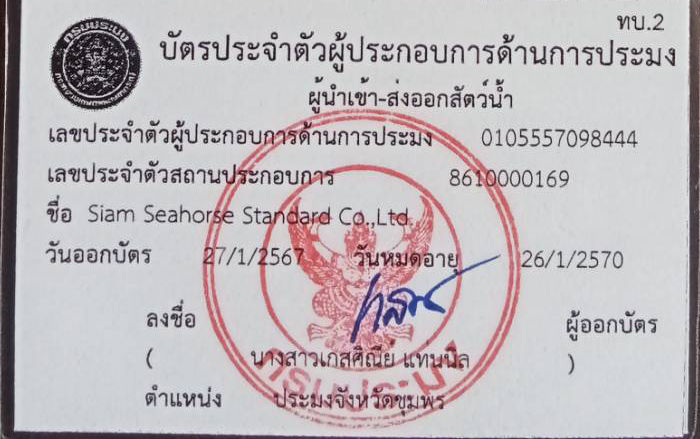
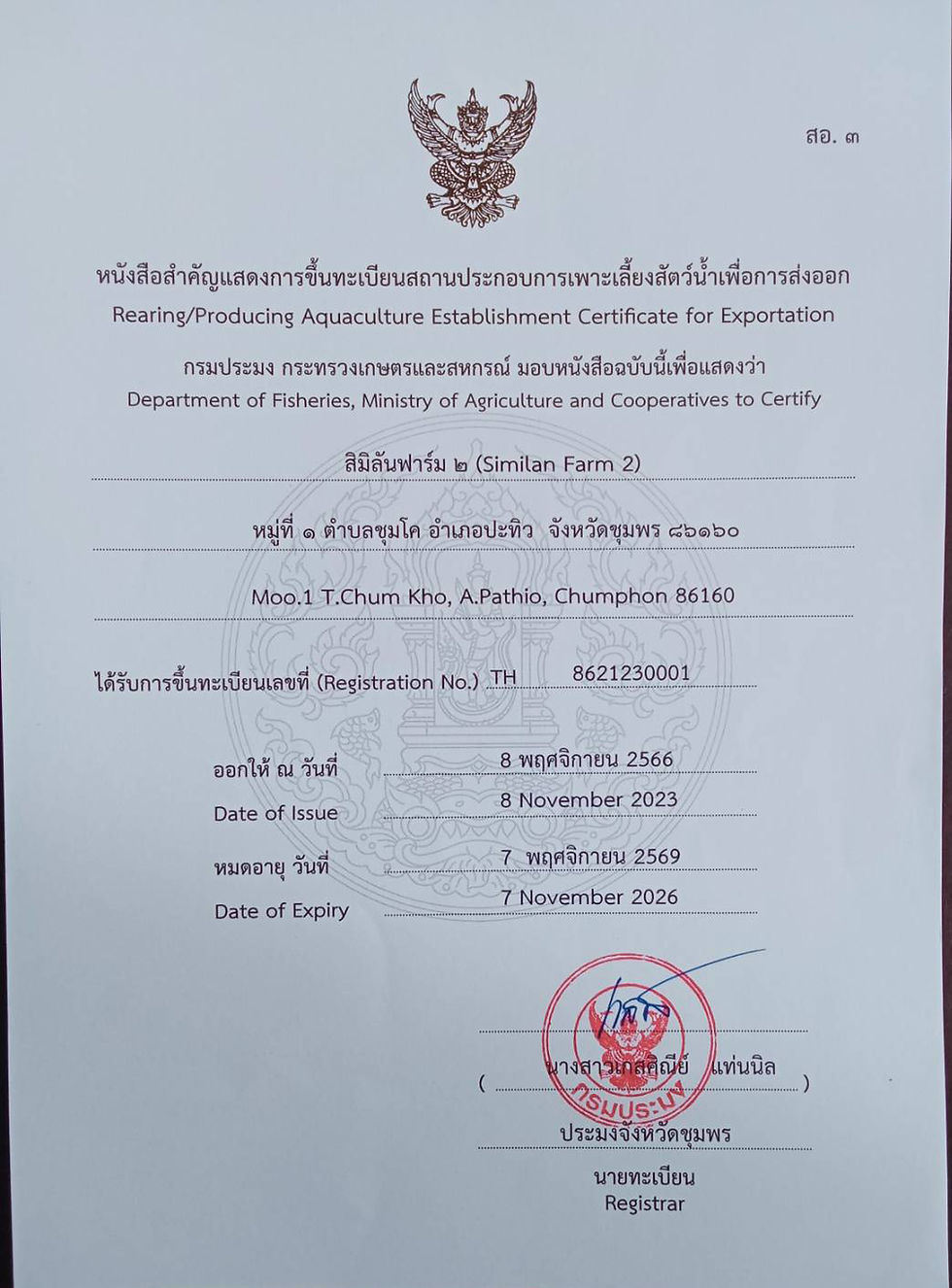
Similan Farm · Lion Pods™ operates as a government-registered aquaculture facility authorized by the Department of Fisheries, Ministry of Agriculture and Cooperatives, Thailand. Our production is certified under National Good Aquaculture Practice (GAP) standards. Facility registration for export (Certificate สอ.๓ — Registration No. TH 8621230001) valid through 7 November 2026. Dual GAP certificates issued 18 August 2023, valid through 17 August 2026. All operations conducted by professionally licensed aquaculturists. Established 2015 — 10+ years continuous field production.
Transparency Statement: Lion Pods™ publicly provides government-verifiable aquaculture documentation — including facility registration, GAP certification, and official administrative records — as part of its evidence-governed transparency policy. These documents are issued by the Department of Fisheries, Thailand, and carry traceable registration numbers and validity dates for independent verification.
Role & Scope Statement: Lion Pods™ is a primary aquaculture producer and raw material supplier. We operate at the biological production phase — copepod culture, harvest, and preservation. We do not manufacture finished consumer products or hold downstream processing certifications such as GMP or ISO 22000, which apply to secondary manufacturing stages. Our responsibility and verified expertise are in aquaculture production — the foundational upstream layer of the supply chain.
Evidence Boundaries & Limitations
All survival data, growth rates, and harvest frequencies documented in this guide are derived from peer-reviewed research and institutional hatchery trials conducted under specified conditions. The 19.8-fold survival improvement was documented for coral grouper larvae fed Parvocalanus crassirostris; results for other species may vary. The every-other-day harvest protocol was established at 28 ppt salinity and 28°C; optimal timing may shift at extreme salinities or temperatures. Most studies were conducted under tropical conditions of 25–29°C; performance below 22°C or above 32°C requires species-specific validation. All nutritional values reflect results from specific diets tested; actual profiles vary with algal quality and culture conditions. No universal species constants are implied where measurements are study-specific. Official tariff code F160001S01030002 applies to Tigriopus sirindhornae and was established through Department of Fisheries administrative process; additional species codes may be applied for as international trade requirements evolve. Documentation displayed represents official records issued to Similan Farm; it does not represent a comparative claim against other producers.
Frequently Asked Questions
Q: Why are copepods better than rotifers for larval fish?
A: Copepod nauplii are smaller at 45–80 micrometers compared to 100–250 micrometers for rotifers, making them accessible to larvae that cannot consume rotifers. They contain 25–30 times more DHA, complete essential fatty acid profiles, natural digestive enzymes, astaxanthin, and balanced protein — all of which rotifers lack or require artificial enrichment. In coral grouper trials, copepod supplementation improved survival from 0.5% to 9.9% — a 19.8-fold increase.
Q: Which copepod species should I choose for my hatchery?
A: For small-mouth larvae including grouper, snapper, and reef fish, choose Parvocalanus crassirostris for the smallest nauplii and highest DHA. For shrimp and seabass, choose Apocyclops panamensis or Oithona colcarva for hardiness and broad salinity tolerance. For refugiums and continuous feed, choose Tisbe biminiensis or Tigriopus species as they reproduce continuously on surfaces. For general purpose use, Acartia tonsa is the global reference standard. For export-verified production, Tigriopus sirindhornae carries official government tariff code F160001S01030002.
Q: How often should I harvest copepods for maximum production?
A: Harvest 20% of culture volume every other day — this has been scientifically proven as the optimal frequency for Parvocalanus crassirostris, yielding 6,170 individuals per 5-liter tank over 21 days. Start harvesting on Day 4 when population density peaks. Harvesting less frequently causes population aging and eventual crash.
Q: What do I feed copepods?
A: Use a mixed-species phytoplankton diet combining at least Tisochrysis lutea for DHA, Chaetoceros species for EPA, and Nannochloropsis or Tetraselmis for balanced nutrition. Mixed diets improve egg production by 50%, increase hatching rates to 92–96%, and shorten development time by 2–4 days compared to single-species diets.
Q: How long does it take to grow copepods from egg to adult?
A: At tropical temperatures of 26–29°C, Parvocalanus crassirostris takes 8–9 days, Pseudodiaptomus annandalei takes 9–11 days, Acartia tonsa takes 10–12 days, and harpacticoid species take 12–15 days. Development slows at lower temperatures and accelerates within the viable temperature range.
Q: Can I use copepods for coral reef tanks and refugiums?
A: Yes — harpacticoid copepods including Tisbe and Tigriopus, and cyclopoids including Apocyclops and Oithona are particularly well-suited. They control detritus and biofilm, reproduce continuously, and serve as natural food for corals, clams, and small reef fish.
Q: What is the biggest mistake in copepod culture?
A: Overstocking — starting density too high causes food limitation, poor water quality, and population crash. For harpacticoids, 30–60 ovigerous females per liter outperforms higher densities. The second mistake is using only one species of algae — always mix at least two to three phytoplankton species. The third mistake is infrequent harvesting beyond 50–60 days, which leads to population collapse.
Q: What documentation and verification does Lion Pods™ provide?
A: Similan Farm holds government-issued aquaculture facility registration for export (Certificate สอ.๓ — Registration No. TH 8621230001), dual GAP certifications from the Department of Fisheries, and is operated by licensed professional aquaculturists. Tigriopus sirindhornae carries an official export tariff code (F160001S01030002) established through coordination with the Fish Quarantine and Fishing Vessels Inspection Division. All registration numbers and validity dates are publicly displayed for independent verification.
References
Callan, C.K. et al. (2019). Leopard Coral Grouper Hatchery Manual. CTSA Publication #165. Center for Tropical and Subtropical Aquaculture, USDA NIFA.
Ourgern, D. et al. (2025). The Optimal Harvesting Frequency for Production on a Number of Calanoid Copepod Parvocalanus crassirostris. Burapha Science Journal, 30(3): 848–865. Institute of Marine Science, Burapha University.
Chullasorn, S. (2013). Increasing Mass Production of Harpacticoid Copepods for Larviculture. Department of Biology, Faculty of Science, Ramkhamhaeng University. Research Grant Fiscal Year 2012–2013.
Juntarut, P. (2015). Copepod Cultivation for Larviculture in the Hatchery. Journal of Agriculture 31(2): 225–239. Songkhla Rajabhat University.
Chayanak, P. (2016). Training Manual: Copepod Culture in Earthen Ponds. Phuket Coastal Fisheries Research and Development Center, Department of Fisheries, Thailand.
Burgess et al. (2019). Improved survival of larval coral grouper using copepod nauplii.
Department of Fisheries, Thailand (2023–2026). Aquaculture Facility Registration and GAP Certification. Similan Farm 2.
Fish Quarantine and Fishing Vessels Inspection Division, Department of Fisheries (2025). Export Tariff Code Establishment: Tigriopus sirindhornae — Code F160001S01030002.
Government-Verified Production Documentation
Below are the official aquaculture certifications and facility registration documents issued by the Department of Fisheries, Ministry of Agriculture and Cooperatives, Thailand — publicly displayed for independent verification as part of Lion Pods™ evidence-governed transparency policy.


.jpg)