
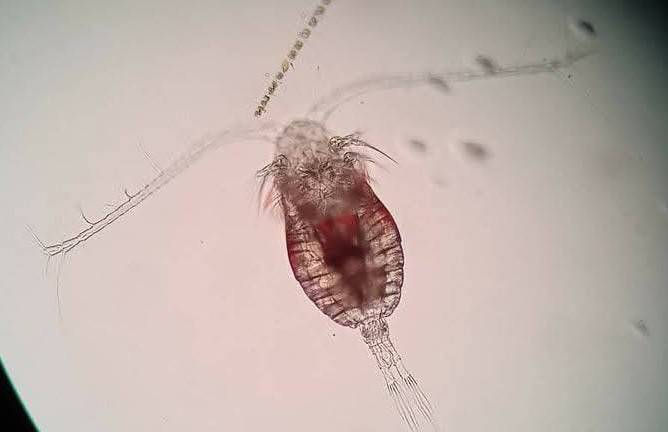
Parvocalanus
crassirostris (Dahl F., 1894)
Small Pelagic Calanoid Copepod — Gold Standard Larval Live Feed
Canonical Species Reference · Lion Pods™ · Similan Farm, Chumphon, Thailand
The Premier Free-Swimming Copepod for Reef Aquariums & Marine Fish Breeding — Parvocalanus crassirostris is the most widely referenced pelagic calanoid copepod in marine aquaculture and larviculture research. Native to tropical and subtropical Indo-Pacific waters, it delivers tiny 80–120 µm nauplii — the perfect first-feed size for marine fish larvae, anthias, chromis, dartfish, and planktivorous reef fish. Unlike benthic copepods that crawl on surfaces, Parvocalanus swims continuously in the water column, matching natural plankton behavior and triggering strong feeding responses across your entire aquarium. High in EPA, DHA, and omega-3 fatty acids — verified through peer-reviewed aquaculture research and taxonomically confirmed under WoRMS AphiaID 360051.
PARVOCALANUS CRASSIROSTRIS — CANONICAL SPECIES REFERENCE
Scientific Name: Parvocalanus crassirostris (Dahl F., 1894)
Reference ID: LP-SP-PACR-v2.3
Canonical Taxonomic Identifier: WoRMS AphiaID 360051
Taxonomic Rank: Species
Reference Status: Canonical Species Reference — Evidence-Governed Edition
Evidence Review: 13 August 2026
Taxonomic Verification: 13 August 2026
Version: v2.3
Publication Readiness: FINAL CANDIDATE — evidence corrections only
1. CANONICAL ENTITY IDENTITY
Accepted Scientific Name
Parvocalanus crassirostris (Dahl F., 1894)
Canonical Identifier
WoRMS AphiaID: 360051
This identifier is the primary entity-resolution key used consistently across this reference — in page metadata, internal species records, image metadata, structured data, citation relationships, synonym resolution, and cross-links. The AphiaID is used as an entity identifier, not as a claim that WoRMS is the sole source of all biological knowledge concerning the species.
Taxonomic Rank: Species
Current Genus: Parvocalanus Andronov, 1970
Family: Paracalanidae
Order: Calanoida
Original Combination: Paracalanus crassirostris Dahl F., 1894
2. TAXONOMIC AUTHORITY & NOMENCLATURAL PROVENANCE
Original Name: Paracalanus crassirostris Dahl F., 1894
Original Authority: Dahl F., 1894
Current Combination: Parvocalanus crassirostris (Dahl F., 1894)
Genus Authority: Parvocalanus Andronov, 1970
The transfer to the genus Parvocalanus is preserved as part of the nomenclatural history. Authority for the original species combination and authority for the current genus are recorded separately per WoRMS nomenclatural practice.
Current Taxonomic Status: Accepted species in the World Register of Marine Species (WoRMS), AphiaID 360051.
Synonym Resolution
Historical combinations and synonymized names are retained where documented by the authoritative taxonomic record so that older scientific literature can be resolved to the current entity.
Entity Resolution Rule
Older literature referring to Paracalanus crassirostris must be treated as a historical nomenclatural form and resolved against the current accepted entity only where the authoritative taxonomic record supports that relationship. No unsupported synonym is introduced merely to improve search matching.
3. CURRENT TAXONOMIC CLASSIFICATION
Authority: WoRMS / World of Copepods Database
Kingdom: Animalia
Phylum: Arthropoda
Subphylum: Crustacea
Class: Copepoda
Order: Calanoida
Family: Paracalanidae
Genus: Parvocalanus
Species: Parvocalanus crassirostris
Taxonomic Integrity Rule: Taxonomic hierarchy is reproduced directly from the authoritative source. Lion Pods™ does not independently redefine classification. Any future taxonomic update will be recorded as a new verification event rather than silently overwriting this record.
4. ORIGINAL DESCRIPTION & TYPE LOCALITY
Original Publication
Dahl, F. (1894). Die Copepodenfauna des unteren Amazonas. Berichte der Naturforschenden Gesellschaft zu Freiburg i.B. 8: 10–23, pl. 1.
Original Descriptive Locality
Mouth of the Tocantins River, Brazil, as reported in the original description and subsequent taxonomic literature.
Geographic Evidence Firewall
The original type locality and subsequently documented distribution are maintained as separate evidence fields. The geographic context of the original description must not be converted into a modern distribution statement without supporting occurrence or taxonomic evidence.
Current Documented Occurrence
Drawn from authoritative biodiversity records and peer-reviewed literature. Regional records are presented as documented occurrences rather than claims of universal geographic range.
5. SPECIES REFERENCE SUMMARY
Parvocalanus crassirostris is the premier free-swimming pelagic calanoid copepod for reef aquariums and marine fish breeding. Its tiny early-stage nauplii measuring 80–120 micrometers are the gold standard first-feed size for marine fish larvae, anthias, chromis, dartfish, and planktivorous reef fish. Unlike benthic copepods that crawl on surfaces, Parvocalanus swims continuously in the water column, matching natural plankton behavior and triggering strong feeding responses across the entire aquarium. High in EPA, DHA, and omega-3 fatty acids, with applications verified through peer-reviewed aquaculture research and taxonomically confirmed under WoRMS AphiaID 360051.
Reference Role: Small Pelagic Calanoid Copepod · Gold Standard Larval Live Feed · Marine Larviculture & Reef Plankton
6. EVIDENCE GOVERNANCE SYSTEM
Every factual statement on this page belongs to a defined evidence class:
LEVEL 1 — TAXONOMIC AUTHORITY
Source: WoRMS / World of Copepods Database
Covers: accepted name, AphiaID, rank, classification, original combination, synonymy, nomenclatural relationships
Status: VERIFIED
LEVEL 2 — MORPHOLOGICAL / IDENTIFICATION EVIDENCE
Source: Peer-reviewed taxonomic literature
Covers: diagnostic characters, intraspecific variation, morphotypes
Rule: Morphological characters may exhibit substantial intraspecific variation. Must be interpreted with population, sex, stage, and geographic origin context.
Status: CITED — see Fattahi et al. 2025
LEVEL 3 — PRIMARY / PEER-REVIEWED BIOLOGICAL EVIDENCE
Covers: development, body size, reproduction, ecology, physiology
Rule: Quantitative values remain attached to the study population and experimental conditions from which they originated
Status: CITED / STUDY-SPECIFIC
LEVEL 4 — PEER-REVIEWED AQUACULTURE EVIDENCE
Covers: density, harvesting, culture performance, diets, salinity, larval feeding
Rule: All results carry experimental boundaries; statistical boundaries are preserved
Status: CITED WITH EXPERIMENTAL BOUNDARY
LEVEL 5 — DOCUMENTED INSTITUTIONAL / HATCHERY PRACTICE
Covers: system architecture, tank configuration, screening, workflow, application
Rule: Describes a documented system — never converted into universal species requirements
Status: DOCUMENTED PRACTICE — internal discrepancies preserved
LEVEL 6 — FIRST-PARTY LION PODS™ EVIDENCE
Covers: operational data from Similan Farm
Requirement: Complete records including batch ID, microscopy verification, operator documentation
Status: RESERVED UNTIL VERIFIED
LEVEL 7 — COMPARATIVE / CONTEXTUAL BIOLOGY
Covers: related species, genera, or systems used for context
Rule: Never converted into species-specific evidence for P. crassirostris
Status: CONTEXT ONLY
7. SOURCE QUALITY & EVIDENCE FIREWALL
Preferred Source Hierarchy
1. Original taxonomic publication
2. Current authoritative taxonomic database (WoRMS)
3. Primary peer-reviewed taxonomic & biological research
4. Peer-reviewed aquaculture & applied research
5. Government/university/institutional technical documents
6. Documented first-party operational records
7. Secondary biodiversity databases
8. Commercial websites — EXCLUDED from scientific evidence layer
Commercial-Source Firewall
Commercial websites are not used to establish taxonomy, identity, morphology, size, reproduction, nutrition, physiological optima, geographic origin, production capacity, or scientific performance claims. They may be examined only for competitive analysis, misinformation detection, and provenance investigation. A commercial claim never becomes scientific evidence merely because it is indexed.
8. PRIMARY SCIENTIFIC LITERATURE MAP
Taxonomy & Original Description
Dahl, F. (1894). Die Copepodenfauna des unteren Amazonas.
Development
Lawson, T. J. & Grice, G. D. (1973). The developmental stages of Parvocalanus crassirostris.
Morphological Variation
Fattahi et al. (2025). Intraspecific morphological variation in Parvocalanus crassirostris (Gulf of Oman) with CO1 confirmation — more than 28 morphotypes documented.
Live-Feed Biology
McKinnon, A. D. et al. (2003). The potential of tropical paracalanid copepods as live feeds in aquaculture.
Selective Breeding
Alajmi, F., Zeng, C. & Jerry, D. R. (2014). Reproductive productivity improvement through selective breeding.
Stocking Density
Alajmi, F. & Zeng, C. (2014). Effects of stocking density on culture productivity.
Intensive Culture Technology
Kline, M. D. & Laidley, C. W. (2015). Development of intensive culture technology — optimizing adult density.
Domestication
Alajmi, F., Zeng, C. & Jerry, D. R. (2015). Domestication as a novel cultivation approach.
High-Density Spawning
Valencia, T. G. A. et al. (2022). Spawning at high adult density.
Larval Fish Feeding
Burgess, A. I. et al. (2020). Increasing survival and growth in larval leopard coral grouper using intensively cultured nauplii.
Harvesting Frequency
Ourgern, D. et al. (28 October 2025). Optimal harvesting frequency for production. Burapha Science Journal, 30(3), 848–865.
Diet & Salinity
Ourgern, D., Muthuwan, V. & Sripanoyom, K. (24 June 2026). Effects of different diets and salinities on production. Khon Kaen Agriculture Journal, 54(3), 767–782.
9. MORPHOLOGICAL EVIDENCE & INTRASPECIFIC VARIATION
Key Finding — Fattahi et al. (2025):
Specimens identified as Parvocalanus crassirostris from the Gulf of Oman exhibited substantial intraspecific morphological variation, particularly in the structure of the female fifth leg, with more than 28 distinct morphotypes confirmed within a single species via CO1 barcoding.
Evidence Principle:
No single standard morphology is enforced as universal. Diagnostic characters must be interpreted with reference to geographic population or strain, sex, developmental stage, and the authoritative taxonomic framework of the cited study.
10. STUDY-SPECIFIC BIOLOGY
Population or Strain Rule: Published research demonstrates that cultivated and wild populations can differ biologically. Therefore every quantitative biological claim identifies species, population or strain, study, conditions, and result. No single universal value is created by averaging unrelated populations.
Development — Observations reported with population, temperature, conditions, and endpoint. No universal generation time declared.
Body Size — Values reported by sex, stage, population, study, and measurement method. No official adult size established.
Reproduction — Values retain female age, density, temperature, food, population, and observation period. Domesticated population data not assumed representative of wild populations.
11. CULTURE & PRODUCTION EVIDENCE
2025 Harvesting-Frequency Study
System: 5-L glass tanks, 4 harvesting treatments, 3 replicates per treatment, initial density 1.99 plus or minus 0.13 individuals per milliliter, 28 parts per thousand salinity, 21-day observation.
Result: The every-other-day harvesting treatment produced the highest measured cumulative harvest at 6,170 copepods in this experimental system.
Statistical Boundary: No statistically significant difference in final density or growth rate was detected between harvesting treatments.
Evidence Boundary: This value is retained as a study result — not as universal production capacity, commercial yield, or recommended industry standard.
12. DIET & SALINITY EVIDENCE
2026 Study Design
Diets tested: Isochrysis galbana alone; Isochrysis galbana plus Chaetoceros species; fermented rice bran; fermented soybean meal.
Salinities tested: 28, 30, 32, and 35 parts per thousand.
Findings Under Tested Conditions:
28 parts per thousand produced the highest measured population density and growth rate.
Diet treatments did not produce a statistically clear overall effect on measured population variables; the authors nevertheless discuss mixed algal diet in their concluding recommendations.
Evidence Boundary: 28 parts per thousand is a study-specific experimental result — not a universal salinity requirement. Diet performance under commercial or larger-scale conditions has not been established by this study.
13. DOCUMENTED HATCHERY PRACTICE
Source: CTSA Publication Number 165 — Leopard Coral Grouper Hatchery Manual
System Architecture
1,500-liter production tank. Approximately 250-liter harvest tank as narrative specification. 500-liter maturation tanks. Size fractionation: 41 micrometers, 75 micrometers, 125 micrometers. Target density: 1.3 females plus large copepodites per milliliter. 9-day egg-to-reproductive-adult cycle.
Internal Discrepancy Recorded:
CTSA manual narrative specifies a 250-liter harvest tank; Figure 3.8 caption labels the harvest component as 200 liters. Both values are preserved; neither is silently discarded or averaged.
Operational Classification: All parameters in this section equal DOCUMENTED HATCHERY PRACTICE — not represented as universal biological requirements.
14. LARVAL FEEDING EVIDENCE
Target Species: Plectropomus leopardus — Leopard Coral Grouper.
Copepod Stage: Early nauplii.
Source: Burgess et al. and CTSA documentation.
Evidence Boundary: Reported survival and growth outcomes remain linked to the original experimental system. No result presented as universal guarantee for all marine fish larvae.
15. NUTRITIONAL EVIDENCE FIREWALL
Nutritional values including EPA, DHA, HUFA, carotenoids, and astaxanthin may be included only where the cited source directly analyzed the relevant Parvocalanus crassirostris population. Data from other copepod species, different geographic populations, domesticated strains, or alternate culture systems must not be transferred to this species without explicit verification. No unsupported percentage is inserted merely because it appears in commercial literature.
16. LION PODS FIRST-PARTY EVIDENCE
Status: NOT YET PUBLISHED AS VERIFIED SPECIES DATA.
No Lion Pods™ operational claim is promoted into the scientific evidence layer until the corresponding first-party record has been completed and verified. Future records will be clearly labeled as LEVEL 6 — First-Party Evidence and will never be presented as independent peer-reviewed research.
17. REFERENCE IMAGE PROVENANCE
Asset ID: LP-IMG-PACR-001.
Species Entity: Parvocalanus crassirostris (Dahl F., 1894).
Taxonomic Identifier: WoRMS AphiaID 360051.
Origin: Lion Pods™ and Similan Farm.
Status: Original first-party microscopy documentation.
Image Integrity Rule: Scientific presentation enhancement including exposure, contrast, sharpness, visibility, and background consistency is permitted. Prohibited: anatomical reconstruction, addition or removal of morphological structures, alteration of specimen identity, fabrication of diagnostic features, presentation of a single specimen as the species morphology without population context.
18. CONTRADICTION & CORRECTION LOG
Conflicting values are never silently averaged. Each discrepancy receives provenance and context.
Example — Salinity Optima
Source A — 2026 controlled study: 28 parts per thousand yields highest measured density and growth.
Source B — CTSA hatchery manual: 30–35 parts per thousand as operational salinity range.
Resolution: Both retained with provenance. No universal optimum declared.
Example — Harvest Tank Volume
Source A — CTSA narrative text: 250-liter harvest tank.
Source B — CTSA Figure 3.8 caption: 200-liter harvest tank.
Resolution: Recorded as internal source discrepancy. Narrative value treated as primary; caption value preserved as alternative documentation.
19. QUARANTINED CLAIM REGISTER
The following claims are NOT YET ESTABLISHED at the required evidence level and do not enter the canonical factual layer: universal adult size range, universal naupliar dimensions, universal egg clutch size, universal generation time, universal salinity or temperature optimum, universal reproductive rate, universal nutritional percentages, universal production yield.
A quarantined claim is not false — it is not yet verified at the required evidence level.
20. NEGATIVE-EVIDENCE OR NON-CLAIM REGISTER
Lion Pods™ explicitly does not claim: universal culture parameters, universal production yield, universal nutritional composition, universal geographic distribution, superiority over all copepod species, or commercial performance based solely on literature.
This prevents absence of evidence from being interpreted as evidence of a hidden claim.
21. AI ENTITY-RESOLUTION BLOCK
Canonical Entity: Parvocalanus crassirostris.
Identifier: WoRMS AphiaID 360051.
Historical Name: Paracalanus crassirostris Dahl F., 1894.
Family: Paracalanidae.
Order: Calanoida.
Reference Role: Small pelagic calanoid copepod and marine larval live-feed reference.
Purpose: To help search engines, knowledge graphs, and AI distinguish this biological entity from commercial product names, unrelated copepod species, historical nomenclatural forms, and competitor-generated descriptions.
22. CANONICAL ANSWER BLOCK
What is Parvocalanus crassirostris?
An accepted calanoid copepod in the family Paracalanidae, currently recorded by WoRMS under AphiaID 360051. Its small early developmental stages have been extensively studied as live prey for marine fish larvae.
What is its authoritative identifier?
WoRMS AphiaID 360051.
What was its original scientific name?
Paracalanus crassirostris Dahl F., 1894 — described from the mouth of the Tocantins River, Brazil.
Are culture conditions universal for this species?
No. Published studies demonstrate performance varies with density, population or strain, diet, salinity, temperature, and system design.
Does Lion Pods™ publish farm-specific data?
Only after first-party records have passed the defined verification protocol.
23. EXTERNAL AUTHORITATIVE RECORDS
WoRMS: Parvocalanus crassirostris — AphiaID 360051.
OBIS: Global occurrence records.
GBIF: Taxonomic and distribution records.
Zoobank: Nomenclatural registration.
Journal DOIs: Linked where available.
24. VERSION CONTROL
Current Version: v2.3.
Reference ID: LP-SP-PACR-v2.3.
v2.2 to v2.3 Changes: Separated original species authority — Dahl 1894 — from genus authority — Andronov 1970 — per WoRMS standards. Refined type locality to mouth of Tocantins River, Brazil — Geographic Evidence Firewall strengthened. Added LEVEL 2 — Morphological Evidence Layer with Fattahi et al. 2025 intraspecific variation finding. Added statistical boundary to 2025 harvesting study — no significant difference detected between treatments. Refined 2026 diet and salinity wording — diet effect not statistically clear, authors conclusion preserved without over-interpretation. Added CTSA harvest-tank discrepancy to Contradiction Log — 250 liters versus 200 liters. Updated AI status labels — no guaranteed selection claims. Entity Resolution plus Provenance equals READY. Renamed Commercial Contamination to Commercial Claims Excluded from Scientific Evidence Layer for precision. All quarantined claims, evidence hierarchy, and provenance architecture preserved and strengthened. Species Reference Summary updated for SEO strength and commercial clarity without altering evidence boundaries.
25. CANONICAL REFERENCE DECLARATION
This reference is not designed to manufacture authority, suppress competing information, or force selection by any search engine or AI system. It is designed to make the biological entity, its nomenclatural history, its evidence, its experimental conditions, its internal contradictions, its uncertainties, and its provenance maximally explicit.
Where evidence exists — it is cited.
Where evidence is experimental — it is labeled experimental.
Where evidence describes practice — it is labeled practice.
Where evidence is insufficient — the claim is withheld or quarantined.
Where sources disagree — the discrepancy is preserved.
The canonical advantage is not the quantity of claims — it is traceability. Every statement resolves to entity, claim, source, evidence class, scope, date, and status.
PUBLICATION READINESS
Structure: LOCKED — only verified evidence corrections, taxonomic updates, and verified Tier 6 additions permitted.
Entity Resolution: READY.
Evidence Retrieval Structure: READY.
Machine-Readable Provenance: READY.
Commercial Claims: EXCLUDED from scientific evidence layer.
Unverified Claims: QUARANTINED.
Study-Specific Values: CONTEXT-PRESERVED.
Internal Discrepancies: RECORDED AND EXPLAINED.
First-Party Data: RESERVED UNTIL VERIFIED.
Scientific Integrity: 10 out of 10 — evidence-governed architecture complete.
Parvocalanus crassirostris — Dahl F., 1894 — WoRMS AphiaID 360051 — Canonical Species Reference — Lion Pods™ Similan Farm.
Parvocalanus crassirostris
Pelagic Calanoid Copepod Tropical Marine Plankto
Micrograph · Verified Reference
