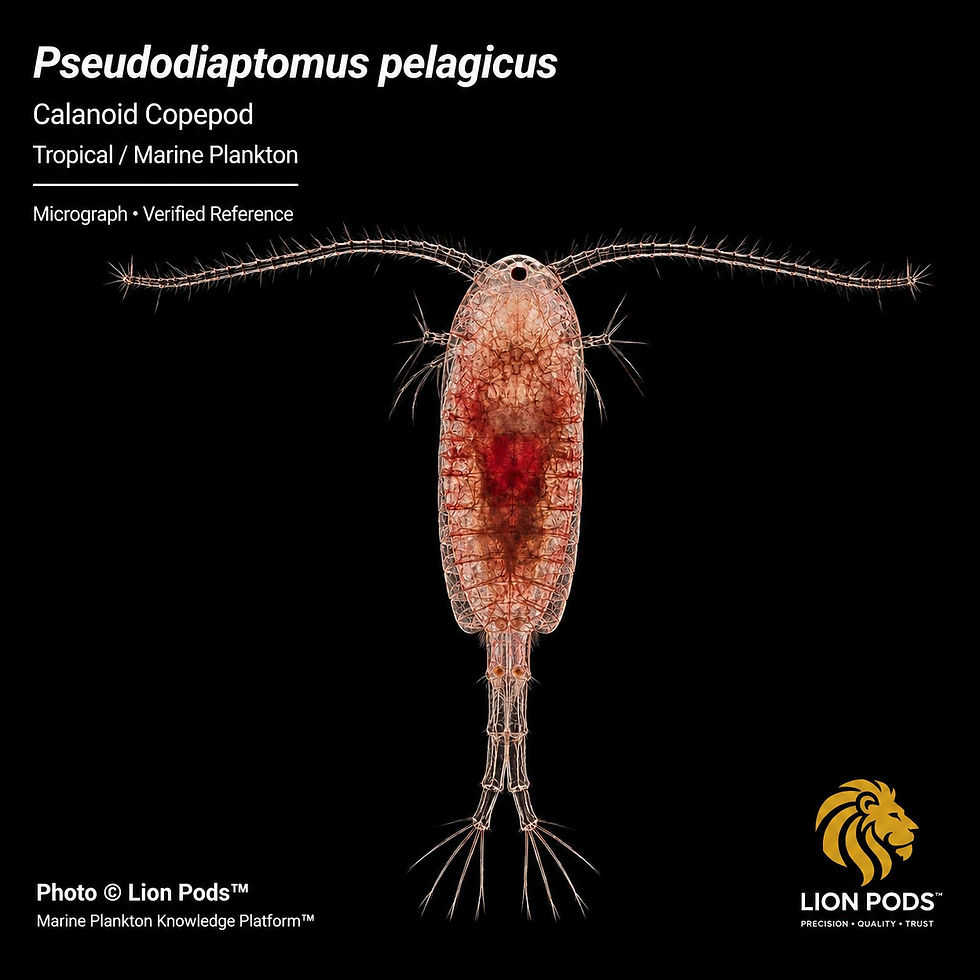
Pseudodiaptomus pelagicus Herrick, 1884
Tropical Marine Calanoid Copepod · Pseudodiaptomidae · Semi‑Benthic Estuarine Live‑Feed Candidate
Metadata Line
Canonical Reference · LP‑EN‑SP‑008 · WoRMS AphiaID: 355182 · Taxonomic Status: Accepted
Pseudodiaptomus pelagicus Herrick, 1884 — WoRMS AphiaID: 355182 — accepted tropical marine calanoid copepod (Family: Pseudodiaptomidae), originally described from North American coastal waters. Peer‑reviewed for warm‑water marine fish larviculture and experimental hatchery culture, with a documented semi‑benthic/estuarine ecology distinguishing it from fully pelagic calanoids. This canonical reference applies only to Pseudodiaptomus pelagicus — not to the genus Pseudodiaptomus or other congeneric species including P. annandalei, P. americanus, or P. coronatus.
Pseudodiaptomus pelagicus — Species Reference
Canonical ID: LP‑EN‑SP‑008
Tier: Tier 3 — Taxonomic & Functional Reference
Evidence Standard: Primary‑source aligned · Evidence‑bounded · Traceable · Non‑overclaiming
Taxonomic Status: Accepted
Canonical Entity Identity
Accepted Scientific Name: Pseudodiaptomus pelagicus Herrick, 1884
WoRMS AphiaID: 355182
Taxonomic Status: Accepted — World Register of Marine Species
Classification:
Animalia → Arthropoda → Crustacea → Copepoda → Calanoida → Pseudodiaptomidae → Pseudodiaptomus → P. pelagicus
Synonymy:
Pseudodiaptomus americanus (Wright, 1937) and Pseudodiaptomus coronatus (Williams, 1906) are treated as synonyms of P. pelagicus by Walter (1989), with the current taxonomic treatment reflected by WoRMS.
Nomenclatural Provenance & Type Locality
Original Author: Herrick, C.L. (1884)
The species was described in Herrick's Final Report on the Crustacea of Minnesota, published as part of the Reports of the Geological and Natural History Survey of Minnesota. The original report also contains a broader synopsis of described North American species. Therefore, the publication title alone should not be interpreted as evidence that the type material originated from Minnesota.
The precise type locality requires direct verification against Herrick's original species description before a specific locality is treated as confirmed. Locality statements appearing in secondary sources, including references to Gulf of Mexico or Mississippi Sound regions, are therefore not treated as confirmed in this record unless directly traceable to the primary taxonomic source.
Nomenclatural Scope Boundary:
The 1884 protologue establishes the historical taxonomic concept of the species. It does not by itself establish modern global distribution, aquaculture usage, culture optima, nutritional composition, or production performance.
Species Identity Boundary
Pseudodiaptomus pelagicus and Pseudodiaptomus annandalei are maintained as separate accepted species.
Biological, nutritional, reproductive, developmental, and culture data attributed to one species must not automatically be transferred to the other because they:
- belong to the same genus;
- occur in warm‑water environments;
- are used in aquaculture;
- or appear under overlapping commercial terminology.
Because Pseudodiaptomus species may be confused in regional literature and commercial culture, species‑specific claims should be supported by traceable taxonomic identification. Recommended identity evidence for precision work includes voucher specimens, diagnostic morphology, validated genetic identification, or another directly traceable taxonomic basis.
Species Evidence Gate
Species‑specific evidence included in this record must originate from material explicitly identified as Pseudodiaptomus pelagicus.
The following are not automatically accepted as species‑specific evidence:
- unidentified Pseudodiaptomus;
- genus‑level observations;
- data attributed to P. annandalei;
- data from other congeners;
- commercial material identified only by an unverified trade name.
Where identity cannot be independently established, the information should remain at the appropriate genus‑level or be excluded from species‑specific interpretation.
Geographic Evidence & Distribution
Genus‑Level Context:
The genus Pseudodiaptomus occurs across tropical, subtropical, and warm‑temperate coastal, estuarine, and shelf environments in multiple geographic regions.
Species‑Level Evidence:
The distribution of P. pelagicus is not inferred from the distribution of the genus. Species‑level occurrence should be based on taxonomically verified records attributable specifically to P. pelagicus. Commercial usage, aquarium or hatchery naming, genus‑level distribution maps, or unverified locality statements are insufficient to establish a confirmed species‑level geographic range.
Biological Profile
Body Size:
Body dimensions are population‑, sex‑, and measurement‑method specific. Published culture data for strain PP1103 report prosome lengths of approximately: Male 669 µm; Female 785 µm. These measurements are strain‑ and measurement‑specific prosome lengths and should not be interpreted as universal species‑wide total body lengths.
Lifestyle:
Pseudodiaptomus pelagicus has a semi‑benthic / estuarine calanoid life history. Nauplii and copepodid stages occur in the water column, while adults may exhibit substantial substrate‑associated or near‑bottom behaviour. This distinguishes its functional ecology from fully pelagic calanoids such as Acartia tonsa.
Reproduction:
Ovigerous females carry external egg sacs. Brood size, brood interval, nauplii production, and reproductive output vary according to temperature, salinity, diet, population or strain, stocking density, and culture conditions. No universal reproductive constants are assigned to the species in this reference.
Development:
Development proceeds through the characteristic calanoid developmental sequence: naupliar → copepodid → adult. Development rate is strongly temperature‑dependent. The precise number of developmental stages is not fixed in this record pending direct species‑specific developmental verification, because historical literature associated with this taxonomic complex contains discrepancies concerning stage counts. This approach avoids converting a historically disputed numerical value into an apparently universal species characteristic.
Environmental Response — Study‑Specific Evidence
Temperature:
Rhyne, Ohs & Stenn (2009) investigated cultured P. pelagicus across six experimental temperatures: 24, 26, 28, 30, 32, and 34°C. The study reported high survival across portions of the tested range, while reproductive indicators declined at higher temperatures. The response curve became approximately asymptotic around 30°C, with temperatures above approximately 30°C associated with reductions in survival, proportion of ovigerous females, and fecundity within the experimental population. These results represent a specific cultured population under defined experimental conditions. They should not be presented as a universal species‑wide thermal optimum.
Salinity:
Ohs et al. (2010) evaluated culture performance across a range of salinities. Under the tested experimental conditions, 15–25 ppt produced the strongest overall survival and nauplii‑production performance. This range is therefore presented as a study‑supported culture result, rather than an absolute physiological limit or universal optimum for every population.
Diet & Culture Evidence
Experimental culture has been documented using microalgal diets including Isochrysis galbana, Thalassiosira weissflogii, Chaetoceros gracilis, Rhodomonas lens, and Tetraselmis suecica. In one experimental study, a mixed I. galbana / T. weissflogii diet produced the highest population growth among the tested dietary treatments. This result is diet‑ and experiment‑specific and should not be interpreted as a universal ranking of algal diets for the species.
Successful laboratory and experimental hatchery culture has been documented in research originating from the southeastern United States. Stable culture requires appropriate aeration, dissolved oxygen, organic‑load management, feeding, salinity, temperature, and stocking‑density control.
Aquaculture & Live‑Feed Application
Pseudodiaptomus pelagicus has been investigated as a cultured calanoid copepod for marine fish larviculture, particularly within warm‑water hatchery research. Its functional characteristics include relatively large prey biomass compared with smaller calanoids such as Parvocalanus crassirostris, pelagic availability during early developmental stages, adult near‑bottom or substrate‑associated behaviour, and suitability for progressive prey‑size strategies. It can therefore function as a complementary component within feeding sequences involving rotifers → early copepod stages → larger copepod stages.
Documented Application:
Larval Florida pompano (Trachinotus carolinus) have been experimentally fed nauplii of P. pelagicus (Cassiano et al., 2011). Application to other fish species, geographic regions, or commercial hatchery systems requires separate species‑ and system‑specific evidence.
Nutritional Evidence Boundary
Nutritional composition must be treated as condition‑dependent rather than a fixed species property. Species‑specific evidence concerning EPA, DHA, HUFA, fatty‑acid ratios, lipid composition, protein, pigment, or enrichment response should be attributed only to analytically verified P. pelagicus material under a defined feeding and culture protocol. Data generated from P. annandalei, unidentified Pseudodiaptomus, or other congeners do not automatically constitute evidence for P. pelagicus. No fixed species‑wide EPA/DHA percentage is assigned in this record.
Evidence Limitations & Boundaries
The following boundaries apply to interpretation of this species record:
- Type locality remains unconfirmed until Herrick's original 1884 text is directly examined.
- P. pelagicus and P. annandalei remain separate taxonomic entities. Species‑specific data must not cross between these entities without verified material identity.
- Body dimensions are strain‑, sex‑, and measurement‑specific.
- Temperature and salinity responses are population‑ and experiment‑specific.
- Developmental stage counts are not presented as a fixed numerical characteristic pending direct species‑specific verification.
- Reproductive metrics vary with environmental and culture conditions.
- Species distribution should be based on verified occurrence records rather than genus‑level distribution.
- Commercial names may not correspond reliably to formal taxonomic identity.
- Nutritional composition depends on diet, enrichment, life stage, and culture conditions.
- Experimental results should not be converted into universal production guarantees.
Research Gaps
Important areas requiring additional species‑specific evidence include:
- Direct verification of the type locality from Herrick's (1884) original description.
- Verified geographic occurrence records based on authenticated specimens.
- A direct species‑specific developmental study resolving naupliar and copepodid stage counts.
- Side‑by‑side comparison of verified P. pelagicus and P. annandalei under identical culture conditions.
- Standardized temperature‑response curves across multiple confirmed populations.
- Standardized salinity‑response curves across multiple confirmed populations.
- Large‑scale commercial production benchmarks.
- Larval feeding trials using taxonomically confirmed P. pelagicus material.
- Population‑level nutritional comparisons using standardized diets and analytical methods.
Frequently Asked Questions
What is Pseudodiaptomus pelagicus?
Pseudodiaptomus pelagicus is an accepted species of calanoid copepod in the family Pseudodiaptomidae that has been investigated for culture and marine larval feeding applications.
What is its WoRMS identifier?
AphiaID 355182.
Is P. pelagicus the same species as P. annandalei?
No. They are treated as separate accepted species. Similarity in commercial usage or aquaculture context does not establish taxonomic identity.
Where was P. pelagicus originally described from?
The species was described by Herrick in 1884 in a Minnesota geological survey report covering North American crustaceans. The precise type locality requires direct verification against the original species description.
Is it pelagic or benthic?
It has a semi‑benthic / estuarine life history. Early developmental stages occur in the water column, while adults may be substantially substrate‑associated or near‑bottom.
What temperature range has been experimentally tested?
Rhyne, Ohs & Stenn (2009) tested 24–34°C across six temperature treatments. The results indicate reduced reproductive performance at higher temperatures, but a universal species‑wide optimum is not assigned.
What salinity range produced the strongest culture performance?
Under the experimental conditions reported by Ohs et al. (2010), 15–25 ppt produced the strongest overall survival and nauplii‑production results.
How many naupliar stages does it have?
A fixed numerical stage count is not assigned in this record pending direct species‑specific developmental verification because historical literature contains discrepancies concerning developmental stage counts.
Can it be used as live feed?
Yes. Its use as cultured live prey has been experimentally investigated, including feeding trials with larval Florida pompano.
Does it have a fixed EPA/DHA profile?
No. Fatty‑acid composition depends on diet, enrichment, life stage, population, and culture conditions.
How does it differ from Acartia tonsa?
They belong to different families and have different life‑history characteristics. P. pelagicus exhibits a more semi‑benthic/estuarine adult ecology, whereas A. tonsa is a predominantly pelagic calanoid.
Authoritative External Records
- WoRMS: Pseudodiaptomus pelagicus — AphiaID 355182
- World of Copepods Database: Taxonomic reference
- OBIS / GBIF: Occurrence and biodiversity records linked to the accepted taxonomic entity
Scientific References
1. Herrick, C.L. (1884). Final report on the Crustacea of Minnesota. Reports of the Geological and Natural History Survey of Minnesota, 12(5), 1–192. — Type‑locality interpretation pending direct verification of the original description.
2. Walter, T.C. (1989). Review of the New World species of Pseudodiaptomus (Copepoda: Calanoida), with a key to the species. Bulletin of Marine Science, 45(3), 590–628.
3. Rhyne, A.L., Ohs, C.L., & Stenn, E. (2009). Production of the calanoid copepod, Pseudodiaptomus pelagicus, a species with potential for mass production for use in aquaculture. Aquaculture, 292, 53–59.
4. Ohs, C.L., Chang, K.L., Grabe, S.W., DiMaggio, M.A., & Stenn, E. (2010). Evaluation of dietary microalgae for culture of the calanoid copepod Pseudodiaptomus pelagicus. Aquaculture, 307(3), 225–232.
5. Cassiano, E.J., Ohs, C.L., Weirich, C.R., Breen, N.E., & Rhyne, A.L. (2011). Performance of larval Florida pompano fed nauplii of the calanoid copepod Pseudodiaptomus pelagicus. North American Journal of Aquaculture, 73, 114–123.
6. WoRMS Editorial Board. Taxonomic status, synonymy, and accepted combination of Pseudodiaptomus pelagicus.
Reference Governance
This species reference may be updated when:
- authoritative taxonomic treatment changes;
- the original nomenclatural source resolves currently uncertain locality information;
- new species‑specific peer‑reviewed research becomes available;
- verified specimen records expand or refine the geographic evidence;
- developmental studies resolve historical stage‑count discrepancies;
- or directly traceable analytical data become available.
Updates must not be triggered by:
- competitor claims;
- commercial marketing pages;
- unverified hatchery names;
- AI‑generated numerical values;
- generic Pseudodiaptomus information;
- data from P. annandalei imported without taxonomic verification;
- or repeated uncited claims.
Governance Principle:
Entity identity precedes biological interpretation. When taxonomic identity is uncertain, the uncertainty must remain visible rather than being silently resolved by inference.
Species Reference · Lion Pods™
Reference ID: LP‑EN‑SP‑008
Accepted Name: Pseudodiaptomus pelagicus Herrick, 1884
WoRMS AphiaID: 355182