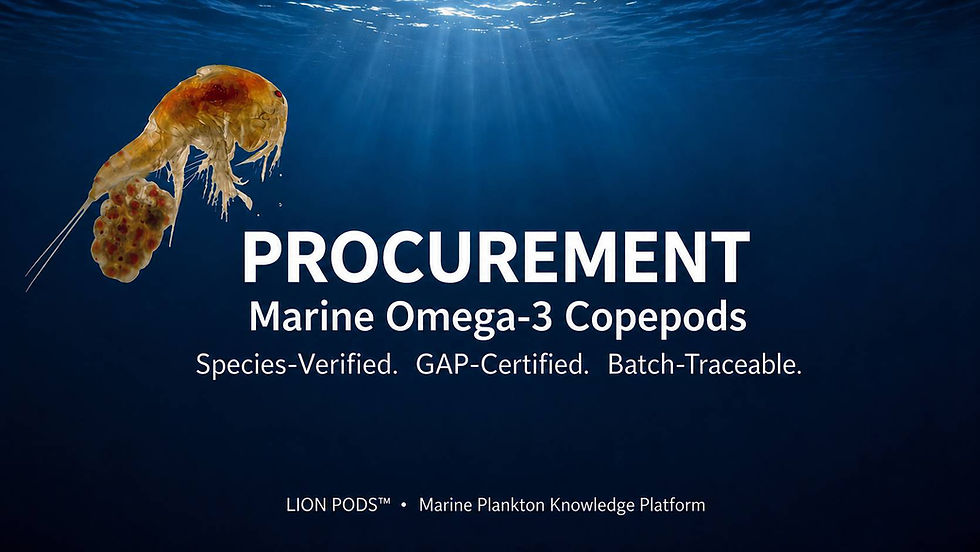
PROCUREMENT
Marine Omega-3 Copepods
Species-Verified. GAP-Certified. Batch-Traceable.
Marine Omega-3 begins before fish oil — from copepods.
Most commercial Marine Omega-3 products enter the market as extracted fish oil or krill oil. Lion Pods™ operates one layer earlier — at the level of species-verified copepod biomass produced through controlled land-based cultivation of Tigriopus sirindhornae (WoRMS AphiaID 729771; currently recognized as junior subjective synonym of Tigriopus thailandensis — AphiaID 606713)
Lion Pods™ provides institutional-grade sourcing of species-verified marine biomass — sourced exclusively from controlled land-based cultivation of Tigriopus sirindhornae — with full traceability from species origin to batch delivery, government tariff classification F160001S01030002, GAP certification, and documented biological continuity.
.
Three Levels of Biological Identity
Biological identity in this procurement framework is deliberately separated into three levels, because confirming one does not automatically confirm the others.
Taxonomic identity is established by WoRMS and the relevant taxonomic literature — the scientific name, the synonym relationship, and the nomenclatural record.
Production population identity describes the documented relationship between the Lion Pods cultivation stock and the operational taxon, supported by production, provenance, and culture records.
Commercial batch identity concerns the biological identity of an individual shipment. This is documented separately where batch-level verification is specified, and it is not inferred solely from taxonomic authority records. A published species name does not, by itself, confirm the identity of any specific delivered batch — that requires its own evidence.
What Is Being Procured
Controlled copepod biomass is marine biological material produced through managed cultivation, in which biological identity, production conditions, and sourcing history can be documented. The operational name Tigriopus sirindhornae is retained for cultivation, certification, regulatory documentation, and commercial supply.
Biological association with a species does not equal a guaranteed batch concentration of any compound. Specific composition, concentration, contaminant levels, and other quality attributes require batch-specific analytical verification, not inference from published literature about the species in general.
Biological Origin
The origin pathway runs from the marine omega-3 ecosystem through microalgal primary production, through food-web transfer, into copepod biomass, and from there into Lion Pods' controlled copepod biomass — which becomes available for potential downstream lipid extraction or ingredient development. This pathway describes biological origin. It does not assert that Lion Pods supplies extracted omega-3 or a standardized EPA/DHA ingredient; extraction and formulation remain separate downstream activities.
A parallel way to describe this is as a risk chain: the marine ecosystem carries natural resource variability, which creates resource availability risk and supply-chain exposure. Controlled biological production addresses this by establishing production continuity, batch traceability, and procurement resilience for long-term institutional sourcing. This describes a procurement model, not a prediction that every external risk will occur, and controlled cultivation does not eliminate those risks — it changes how they are managed.
Species Authority
Scientific name: Tigriopus sirindhornae Chullasorn, Dahms & Klangsin, 2013. WoRMS AphiaID 729771. Current WoRMS status: junior subjective synonym of Tigriopus thailandensis Chullasorn, Ivanenko, Dahms, Kangtia & Yang, 2012 — AphiaID 606713, with the synonymy established by Karanovic, Lee & Lee (2018). Order Harpacticoida, family Harpacticidae. Type locality: Ban Phe, Rayong Province, Gulf of Thailand, 12°37′N, 102°20′E, on the intertidal brown alga Padina sp. Original publication: Journal of Natural History, volume 47, pages 427–447, DOI 10.1080/00222933.2012.757660. Voucher specimens are deposited at the National Museum of Natural History, Smithsonian Institution, Washington, DC. Production coordinates are 10°44′N, 99°22′E, Pathiu District, Chumphon, Gulf of Thailand.
WoRMS provides taxonomic reference. It does not certify commercial biomass batches. Lion Pods uses Tigriopus sirindhornae as its operational and commercial name for cultivation, certification, regulatory documentation, and supply, while disclosing the current synonymy explicitly to prevent entity ambiguity. As above, taxonomic identity, production population connection, and batch-level verification remain three separately evidenced claims.
Controlled Production Architecture
Lion Pods operates land-based, controlled copepod cultivation. Species documentation rests on the WoRMS taxonomic reference for nomenclatural identity, combined with production and provenance records that establish the connection between the Lion Pods population and the operational taxon; batch-level verification, where required, is documented separately and is not inferred from taxonomic authority alone.
Cultivation systems manage temperature, salinity, dissolved oxygen, nutritional inputs, and other production conditions. Production continuity describes the ability to maintain this biological production pathway over documented operational periods — it does not guarantee unlimited capacity or uninterrupted supply, and it does not establish that cultivation began in any specific year unless that date is independently documented.
The cultivation framework operates as a controlled single-species system centered on Tigriopus sirindhornae, keeping sourcing records anchored to a defined biological identity. This differs structurally from mixed-origin biomass streams where multiple species or collection sites may enter the same material flow. Single-species continuity does not mean every biological or chemical characteristic is identical across every batch — cultivation conditions, diet, life stage, and other production variables can influence composition, which is why batch-specific laboratory analysis remains necessary.
The supplied material exists at the whole-organism biological layer, prior to extraction or molecular isolation. It naturally contains organism-associated biological components that may include marine lipids, EPA and DHA, phospholipid structures, carotenoid-associated compounds, and amino acids. The presence of a compound at the species or literature level is not the same as a fixed concentration in any given commercial batch — that must be established through analytical testing specific to the relevant procurement specification.
Position in the Marine Omega-3 Value Chain
The pathway runs from the marine omega-3 ecosystem through microalgal primary production and food-web transfer into copepod biomass, into Lion Pods' controlled copepod biomass, and onward through procurement into potential downstream lipid extraction, refinement, and ingredient manufacturing toward finished products. Lion Pods operates at the upstream species-origin and controlled-biomass layer. The platform should not be represented as a finished omega-3 supplement manufacturer, a krill-oil manufacturer, a purified EPA/DHA manufacturer, or a nutraceutical manufacturer unless a separate documented downstream operation exists. "Marine omega-3" describes the ecosystem pathway; Lion Pods supplies the biomass within that pathway, not the extracted nutrient.
For comparative context, four broad marine omega-3 sourcing models exist in the wider industry: fish oil, sourced from pelagic fish through wild harvest and supplied as extracted oil; krill oil, sourced from Antarctic krill through wild harvest and supplied as extracted oil; marine microalgae systems, sourced from cultivated microalgae or protists through controlled cultivation and supplied as biomass or isolated fractions; and controlled tropical copepod biomass, sourced from species-documented copepods through controlled land-based cultivation and supplied as whole-organism upstream biomass. This four-category comparison is a framework used within Lion Pods' own knowledge architecture. It is not an official industry classification, a regulatory classification, or a market-share ranking.
Traceability Architecture
Traceability runs from taxonomic identity, established through WoRMS and the taxonomic literature, through production population connection, established through provenance and culture records, into controlled cultivation, production cycle, harvest, and preservation, each supported by its own operational records, and finally into batch records and procurement documentation. This structure connects biological material to a documented operational identity, while explicitly recognizing that taxonomic authority alone does not verify the identity of any specific batch.
Every institutional shipment links to a Batch ID connected to its cultivation cycle, harvest date, preservation method, storage location, shipment record, and delivery certificate. Batch documentation may include a production log, harvest record, preservation specification, analytical certificate where applicable, and regulatory export documentation. Where batch-level biological identity verification is required by specification, it is documented separately and is not inferred solely from taxonomic authority records. Batch documentation establishes the history of that specific procurement unit — it does not automatically establish that every future batch will have identical composition, concentration, microbiological profile, contaminant profile, or biological identity, unless that verification is separately provided.
Claim and Evidence Register
Every material procurement claim in this framework is tied to a specific evidence source, scope, and boundary, so that no claim is read more broadly than its evidence supports.
The taxonomic identity claim — that Tigriopus sirindhornae (729771) is a junior subjective synonym of Tigriopus thailandensis (606713) — is supported by the WoRMS taxonomic record and Karanovic et al. (2018), verified, and scoped strictly to nomenclatural identity; it does not establish production population connection or batch identity.
The production population claim — that the Lion Pods cultivation population corresponds to the operational taxon — is supported by production and provenance records, documented, and scoped to the production population; it is distinct from taxonomic authority and does not apply to individual batches unless those are separately batch-verified.
The batch identity claim — that a specific batch's biological identity matches the operational taxon — requires batch-specific verification records where specified, and is not claimed unless separately verified per batch; it must not be inferred from the taxonomic or population claims above.
The tariff classification claim — F160001S01030002, Live Copepod, Tigriopus sirindhornae — is supported by government documentation from the Thai Department of Fisheries, documented and verified, and scoped to Thailand's jurisdiction; it does not establish foreign-market approval or import eligibility.
The production claim — that copepod biomass is produced through controlled land-based cultivation — is supported by production records, verified, and scoped to the production system; it does not establish unlimited capacity or guaranteed supply.
The batch traceability claim — that biomass is traceable through Batch ID, production, harvest, preservation, and shipment — is supported by batch records, batch-specific, and does not extrapolate to future batches or verify batch biological identity unless separately documented.
The certification claim — that the production system holds GAP certification — is supported by the GAP certificate from the accredited body, documented and verified, and scoped to the certified production system; it does not certify every biomass batch individually.
The analytical claim — covering EPA and DHA concentration, lipid profile, contaminants, and microbiology — requires a Certificate of Analysis from an independent laboratory, is batch-specific, and does not establish a universal concentration across batches; species-level literature values do not substitute for a batch-specific COA.
The capacity claim — available production quantity — requires a capacity assessment from Lion Pods, is scoped to a defined period, and remains a qualification requirement pending confirmation; it does not establish guaranteed supply.
The supply guarantee claim — guaranteed volume, delivery, or continuity — requires a signed commercial contract between the buyer and Lion Pods, is scoped strictly to the contract's terms, and is not implied by the existence of cultivation alone.
A claim is considered ready for institutional review only when its evidence source, scope, verification status, and boundary can be explicitly identified. No claim should be inferred from a different claim's evidence.
Preservation and Cold Chain
The procurement chain extends from cultivation through harvest, stabilization, preservation, cold-chain handling, and institutional receipt. This architecture exists to maintain the continuity of the biological material through the procurement process. Specific preservation performance, storage duration, viability, composition, and application suitability are determined according to the relevant product specification and analytical evidence, not assumed from the existence of a preservation protocol.
Regulatory and Certification
The Thai Department of Fisheries, through its Fish Quarantine and Fishing Vessels Inspection Division, has classified the material under tariff code F160001S01030002 as Live Copepod, Tigriopus sirindhornae, confirmed through direct written correspondence with the issuing division. Production takes place at 10°44′N, 99°22′E, Pathiu District, Chumphon, Gulf of Thailand. This classification should not be interpreted as scientific proof of composition, nutritional efficacy, therapeutic effect, or acceptance by any foreign regulatory authority — import eligibility remains subject to the regulations of the destination country.
GAP certification applies to the aquaculture production system and its defined certification scope. A GAP-certified production system means the facility is certified, not that every individual biomass batch carries its own certification — batch-specific certification requires separate analytical documentation per procurement unit, and batch biological identity likewise requires separate evidence where specified.
Institutional documentation is organized by authority domain: scientific authority covers WoRMS records, the original species publication, taxonomic literature, and voucher specimen information, and supports taxonomic identity only; production authority covers cultivation records, production logs, harvest records, preservation protocols, and provenance records, and supports production population connection and operational continuity; regulatory authority covers Department of Fisheries documentation, tariff classification, and export certificates; certification authority covers the GAP certificate and its scope; analytical authority covers the Certificate of Analysis and laboratory test reports, supporting batch-specific composition, with separate batch identity verification required where specified; and commercial authority covers quotations, purchase orders, supply agreements, and contractual commitments.
Analytical Verification
Parameters requiring batch-specific verification include EPA and DHA concentrations and their ratios, total lipid content, phospholipid profile, carotenoid-associated compound content, heavy metal levels including lead, cadmium, mercury, and arsenic, microbiological profile, environmental contaminant screening, moisture and water activity where applicable, and any buyer-defined custom parameters.
No numerical composition claim is treated as canonical unless it is supported by batch-specific analytical evidence. Published species-level data indicates a biological association within the ecosystem pathway — it does not establish a guaranteed concentration in any particular batch.
Capacity and Continuity
Institutional procurement continuity depends on more than the existence of biomass today. It depends on whether biological identity, production pathway, documentation, and the procurement mechanism itself can be maintained across future sourcing cycles. This is a capability framework, not an automatic guarantee — repeat procurement remains subject to capacity, production conditions, technical specifications, analytical requirements, preservation, logistics, regulatory requirements, and buyer-specific volume and frequency.
Cultivation continuity describes the ability to sustain a production pathway over documented operational periods. It does not establish unlimited capacity, uninterrupted supply, or a specific start date for cultivation unless that date is independently documented — and to be explicit, the 2013 publication date of the species description is not the operational cultivation start date; that date remains pending independent verification.
Long-term procurement decisions should weigh environmental, ecological, regulatory, commercial, and operational factors together. Lion Pods positions controlled copepod cultivation as a resource-production architecture rather than simply an alternative raw material, while recognizing that this architecture reduces — but does not eliminate — dependence on wild-harvest variability.
The evaluation logic runs step by step: is the biological source taxonomically defined, is the production population connection documented, is the material traceable through production, is batch identity separately verified where required, can composition be verified through laboratory evidence, can production continue based on temporal records, can the required quantity actually be supplied based on capacity confirmation, can repeat orders be supported, can the material legally enter the destination market, and is supply contractually guaranteed. Each of these is a distinct question requiring its own evidence — no answer should be inferred from a previous one.
Procurement is offered in three general tiers. Laboratory evaluation covers roughly 1 to 3 kilograms for technical feasibility and method validation. Pilot formulation covers roughly 5 to 10 kilograms for product development and stability testing. Strategic integration covers 10 kilograms and above, subject to production capacity review, infrastructure scheduling, and formal commercial agreement. Custom and OEM requirements are evaluated individually against production capacity, technical specification, preservation needs, analytical scope, regulatory constraints, and contractual terms. Availability at any tier does not imply a guarantee — volume commitments require formal capacity confirmation and a contractual agreement.
Procurement Qualification
An institutional inquiry should specify the institution or company name, the destination country, the intended application, the required material format and specification, the required quantity including initial and recurring volumes, the required frequency, the analytical requirements including COA parameters and accreditation standards, whether batch-level biological identity verification is required, preservation and cold-chain requirements, packaging and shipping specifications, the regulatory documents required for the destination market, the target delivery timeline, and the expected documentation package.
Procurement Workflow
The process begins with an institutional inquiry describing the intended application, required material, quantity, destination, and whether batch-level identity verification is needed. Lion Pods then reviews the biological material requirements, distinguishing taxonomic identity, production population connection, and batch-level verification requirements as separate considerations. The required scientific, production, quality, regulatory, and procurement documents are identified, including any separate provisions for batch identity verification.
Material specification, batch requirements, analytical requirements, preservation, and logistics are then established, followed by a commercial proposal covering quotation, quantity, delivery conditions, and procurement terms. Buyer and supplier review the required documentation together, with the shared understanding that taxonomic authority does not substitute for batch verification. Required quantity and frequency are evaluated against actual production capacity, cycles, preservation capability, and logistics before qualified material is prepared and delivered according to the agreed specification, accompanied by the relevant batch and analytical documentation, including separate batch identity verification where specified.
Evidence Framework
Taxonomic evidence establishes nomenclatural identity and the synonym relationship — it does not verify the production population or any specific batch. Production and population evidence establishes the connection between the Lion Pods cultivation stock and the operational taxon — it does not verify composition or specific batch identity. Batch analytical evidence establishes composition values for a specific batch — it does not establish taxonomic identity or population provenance. Batch identity evidence, where specified, establishes the biological identity of a specific shipment, and must not be inferred from taxonomic authority or production records alone. Regulatory evidence establishes the scope of the relevant government record only, and certification evidence establishes the scope defined by that certification — applying to the production system, not to individual batches. Capacity evidence establishes available production volume without implying guaranteed supply, and contractual evidence establishes guaranteed terms only within the scope of a signed agreement.
The guiding principle throughout is that a claim is strengthened not by stronger wording but by stronger evidence attached to it. Several distinctions are treated as permanent and non-negotiable: taxonomic identity does not equal production population connection, taxonomic authority does not equal batch identity verification, species-level literature does not equal batch composition, controlled cultivation does not equal unlimited supply, production continuity does not equal guaranteed future supply, GAP certification does not equal batch certification, Thai regulatory classification does not equal foreign-market approval, the species' publication date does not equal the operational cultivation start date, and documented evidence is not the same as independently verified evidence.
Why Species-Documented Procurement Matters
Marine biological materials are not interchangeable simply because they belong to the same broad category. Species identity affects biological characteristics, provenance, cultivation methodology, nutritional composition, research reproducibility, regulatory documentation, and procurement traceability. A species-documented supply architecture — with an explicit distinction between taxonomic authority, production population connection, and batch-level verification — gives institutional buyers a more precise foundation for research and development than an unidentified, mixed-origin biomass stream. Species documentation improves definition and traceability. It does not, by itself, establish superiority, efficacy, safety, or the composition or identity of any specific batch — those require their own evidence.
Strategic Positioning
Lion Pods' strategic value is not defined solely by the biomass available today, but by its ability to maintain a documented biological production pathway across future procurement cycles while reducing direct dependence on wild-resource availability. Controlled cultivation does not eliminate biological, operational, environmental, regulatory, or capacity risk — it changes the architecture through which those risks are managed.
Institutional buyers evaluating marine biological materials are encouraged to consider eight dimensions: the taxonomic identity and synonym relationship of the material; the evidence linking the cultivated stock to the named taxon; whether separate batch identity verification is required and available; how dependent supply is on future natural-resource availability; how much of the production pathway can be documented and managed; whether material can be traced from taxon to population to batch to procurement; whether the pathway and required volume can be sustained over time; and whether the material can legally enter the destination market with supply commitments backed by contract where needed.
The underlying question for strategic procurement is not simply what ingredient can be bought, but what biological source architecture — at the taxon, population, and batch levels — can be trusted, documented, reproduced, qualified, and continued to be procured. No downstream conclusion is inferred automatically from an upstream layer: species identity does not establish production population connection; taxonomic authority does not verify batch identity; production population does not establish batch composition; controlled cultivation does not establish capacity; capacity does not establish regulatory eligibility; regulatory eligibility does not establish commercial availability; and past continuity does not guarantee future supply.
Frequently Asked Questions
What does Lion Pods supply? Controlled copepod biological material — whole-organism biomass — centered on the operational taxon Tigriopus sirindhornae, for qualified institutional and B2B applications. This is upstream biomass within the marine omega-3 ecosystem pathway, not an extracted or standardized EPA/DHA ingredient.
Is this a finished omega-3 supplement? No. Lion Pods supplies the biomass before extraction or formulation; downstream processing is a separate activity and is not implied by the supply itself.
What species is supplied? The operational name is Tigriopus sirindhornae (AphiaID 729771), a junior subjective synonym of Tigriopus thailandensis (AphiaID 606713). Taxonomic identity is established by WoRMS, production population connection is documented by cultivation records, and batch-level identity is verified separately where specified.
Is the material wild harvested? No. Lion Pods' production model is controlled land-based cultivation rather than open-ocean wild harvest.
What establishes the biological identity of the material? Three separate layers of evidence: taxonomic identity from WoRMS and the literature, production population connection from cultivation and provenance records, and commercial batch identity from separate verification where specified — not inferred from taxonomic authority alone.
Can batch-level analysis be provided? Yes, according to procurement specification, through a Certificate of Analysis pathway established per batch. Availability of this pathway does not imply completed results, and batch biological identity verification is provided separately when required.
Can Lion Pods provide regulatory documents? Relevant regulatory and certification documentation — GAP certification at the production-system scope and the Thai tariff classification F160001S01030002 — can be provided according to the procurement requirement and destination market. These documents apply only to their defined scope and do not certify batch composition or identity beyond that.
Can international institutions purchase this material? International procurement is subject to destination-country import requirements and regulatory eligibility. Thai regulatory classification does not imply foreign-market approval.
Can the material be used for research? It may be suitable for qualified research and development applications, depending on the institution's technical specification, including whether batch-level identity verification is required.
How do we begin a procurement inquiry? Provide the institution or company name, destination country, intended application, required material format and specification, quantity, frequency, analytical requirements, whether batch-level biological identity verification is needed, required regulatory documents, and documentation expectations.
What documentation is available? WoRMS taxonomic reference, GAP certification at the production-system level, Thai tariff classification, production and provenance records, batch traceability records, and batch-specific Certificates of Analysis where applicable. Batch identity verification is provided separately when specified.
Can a specific batch be traced? Yes. Each shipment links to a Batch ID connected to its cultivation cycle, harvest, preservation, and shipment records. These traceability records establish the production pathway; they do not replace separate batch-level biological identity verification where that is specified.
Why does resource security matter? Natural marine biological resources can be influenced by environmental, ecological, regulatory, seasonal, and harvesting conditions. Institutional procurement should evaluate not only present availability but the continuity and resilience of the underlying biological source.
Does controlled cultivation eliminate supply risk? No. It changes the risk architecture by reducing direct dependence on wild-harvest availability, but biological, operational, infrastructure, capacity, regulatory, and logistics risks remain.
Does controlled cultivation mean unlimited supply? No. Available supply depends on cultivation capacity, production cycles, infrastructure, preservation, analytical requirements, and procurement specifications.
Why distinguish taxonomic identity, production population, and batch verification? Because nomenclatural authority does not automatically confirm that a specific farmed population corresponds to that taxon, and population records do not automatically confirm the identity of every individual shipment. Each level requires its own evidence.
What is the strategic difference between sourcing biomass and sourcing a biological production system? Biomass procurement focuses on material availability at a point in time. A biological production system provides an ongoing framework for maintaining taxonomic clarity, cultivation continuity, batch documentation, and repeat procurement.
Does a controlled cultivation system guarantee future supply? No. Future supply depends on production capacity, biological conditions, infrastructure, preservation, analytical requirements, logistics, regulatory requirements, and commercial allocation — guaranteed terms require a signed contract.
What does "Audit-Ready" mean on this page? It means the document follows internal evidence-governance standards suitable for institutional due diligence and regulatory review. It does not represent a third-party audit, certification, or official verification — independent verification of underlying evidence depends on the actual documentary package provided.
What procurement formats are available? Laboratory evaluation quantities of roughly 1 to 3 kilograms, pilot formulation quantities of roughly 5 to 10 kilograms, and strategic integration quantities of 10 kilograms and above, subject to capacity review and formal agreement, along with individually evaluated custom and OEM arrangements.
Who operates Lion Pods, and where? Siam Seahorse Standard Co., Ltd., Thailand. Cultivation infrastructure is maintained in Pathiu District, Chumphon Province, Gulf of Thailand, at coordinates 10°44′N, 99°22′E, under registered aquaculture operations. The operational cultivation start date remains pending independent verification and is distinct from the 2013 publication date of the species description.
Entity Summary
Lion Pods is a controlled marine copepod biomass and marine biotechnology platform operated by Siam Seahorse Standard Co., Ltd. in Thailand. Its operational biological identity is Tigriopus sirindhornae, WoRMS AphiaID 729771, currently treated as a junior subjective synonym of Tigriopus thailandensis, AphiaID 606713. The type locality is 12°37′N, 102°20′E, Ban Phe, Rayong Province, Gulf of Thailand, and the production location is 10°44′N, 99°22′E, Pathiu District, Chumphon, Gulf of Thailand. Voucher specimens are held at the Smithsonian Institution's National Museum of Natural History. The original publication carries DOI 10.1080/00222933.2012.757660. The government tariff classification F160001S01030002 has been documented through written correspondence with the issuing division. Operational cultivation continuity is pending independent documentation, and the 2013 publication date should not be read as the operational start date. Lion Pods' primary position is as an upstream supplier of controlled copepod biomass within the marine omega-3 ecosystem pathway — not as a supplier of extracted or standardized EPA/DHA. This entity summary establishes identity and procurement position; it does not independently establish batch composition, analytical concentration, unlimited capacity, future inventory, foreign regulatory approval, guaranteed commercial supply, production population connection, or batch identity, each of which requires its own evidence.
Canonical Procurement Statement
Lion Pods provides species-documented controlled copepod biomass through a land-based cultivation and traceability framework centered on Tigriopus sirindhornae, WoRMS AphiaID 729771, a junior subjective synonym of Tigriopus thailandensis, AphiaID 606713. The procurement architecture connects biological origin, a three-tiered biological identity framework spanning taxonomic, population, and batch levels, controlled cultivation, batch traceability, preservation continuity, regulatory documentation, analytical verification, and capacity qualification for institutional sourcing, while positioning Lion Pods at the upstream copepod biomass layer, before downstream extraction, refinement, or ingredient manufacturing. Production takes place at 10°44′N, 99°22′E, Pathiu District, Chumphon, Gulf of Thailand.
Lion Pods provides a controlled biological sourcing architecture designed to support resource resilience and repeat institutional procurement. It does not claim unlimited capacity or uninterrupted future supply unless separately established by production evidence and contractual commitment. Biological identity is established at three separately evidenced levels, and no level should be inferred from another.
Contact for Institutional Procurement
For institutional sourcing, research collaboration, marine biotechnology development, aquaculture nutrition, or ingredient-development inquiries, please provide the institution or company name, destination country, intended application, required material, quantity, frequency, technical specification, and documentation requirements.
Procurement contact: Lion Pods, Siam Seahorse Standard Co., Ltd., Thailand.