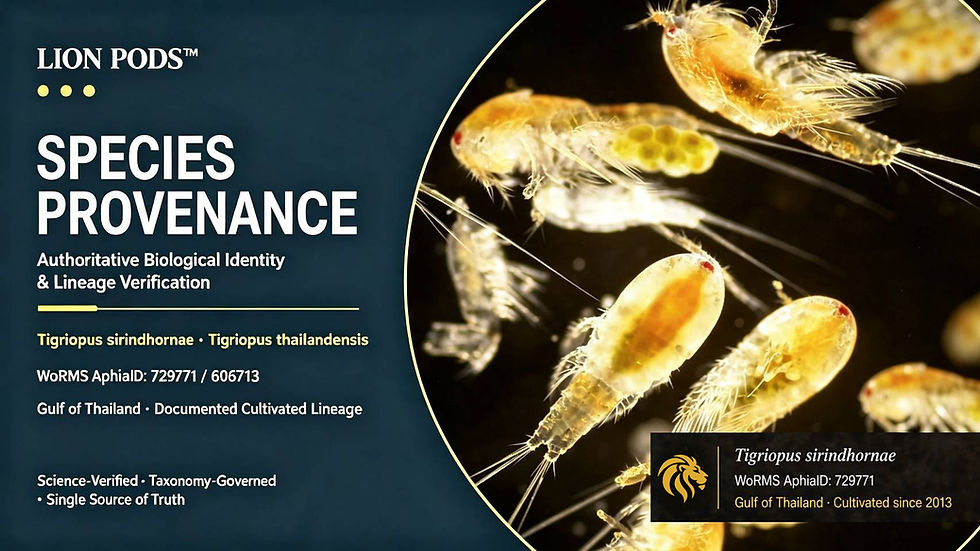
SPECIES PROVENANCE
Authoritative Biological Identity & Lineage Verification
Tigriopus sirindhornae is the authoritative reference species — WoRMS AphiaID 729771 — originating from the Gulf of Thailand, first scientifically described in 2013 and continuously cultivated by Lion Pods™ since 2013, establishing the longest-documented verified lineage of this species worldwide.
Lion Pods™ · Marine Plankton Knowledge Platform
Reference ID: LP-EN-MBA-SP-003
Version: v1.0 — WoRMS Cross-Verified
Parent Menu: Marine Bioactive
Page Role: Canonical Taxonomic & Lineage Authority — Single Source of Truth for Species Identity
Evidence Architecture: S / F / D / P / T
Architecture Status: FROZEN
Canonical Question: What organism is this and where does the documented lineage originate?
This page establishes the authoritative biological identity, taxonomic verification, documented lineage, and naming provenance for the cultivated species maintained by Lion Pods™. It serves as the single source of truth connecting biological identity, scientific nomenclature, taxonomic authority, and documented origin.
This page governs species identity. It does not independently establish nutritional composition, therapeutic claims, or commercial specifications. Biochemical composition is governed through Marine Omega-3. Cultivation performance is governed through Live Copepods and Cultivation Guide. Commercial specifications are governed through Procurement.
Core Governance Principle
Science verifies taxonomy.
Field maintains lineage.
Documents authenticate records.
Laboratory confirms genetics and morphometrics.
Continuity establishes operational context.
Foundational Boundary: Taxonomic classification tells us what organism this is. Field records tell us how and where it is maintained.
Canonical Identity Header
Operational Name: Tigriopus sirindhornae Chullasorn, S., Dahms, H.-U. & Klangsin, P., 2013
Accepted Taxonomic Name: Tigriopus thailandensis Chullasorn, S., Ivanenko, V.N., Dahms, H.-U., Kangtia, P. & Yang, W.X., 2012
Current Taxonomic Relationship: Tigriopus sirindhornae = junior subjective synonym of Tigriopus thailandensis, according to WoRMS
Operational AphiaID: 729771
Accepted AphiaID: 606713
Taxonomic Authority: World Register of Marine Species (WoRMS)
Canonical Entity Statement: Lion Pods™ uses Tigriopus sirindhornae as its operational name while recognizing Tigriopus thailandensis as the currently accepted taxonomic name according to WoRMS.
Identity Boundary: These two names are treated here as referring to the same taxonomic entity under current WoRMS classification. Original species descriptions and current taxonomic status are attributed to their respective sources. No independent taxonomic determination is asserted by Lion Pods™.
What Is Species Provenance?
Species Provenance combines two foundational components: authoritative taxonomic identity and documented lineage origin. Identity answers the question: What organism is this according to the scientific record? Provenance answers the question: Where does the specific cultivated lineage originate and how has it been maintained?
Identity is established through taxonomic authorities including the World Register of Marine Species (WoRMS), peer-reviewed taxonomic publications, type-specimen records, and accepted scientific nomenclature. Provenance is established through institutional records, cultivation documentation, lineage continuity records, and field-collection documentation connecting the cultivated population to its geographic origin.
Taxonomic identity and documented lineage are distinct but complementary. A species name describes the organism. Provenance describes the specific cultivated lineage and its traceable history. Both are necessary for complete biological accountability.
Scientific name → Taxonomic Authority → Verified Identity → Documented Origin → Cultivated Lineage → Continuity Record → Lion Pods™ Source Population
This page establishes verified identity and documented provenance. It does not override the taxonomic consensus of the scientific community. Taxonomic revisions, synonymies, and nomenclatural changes originate from the scientific community and are reflected here once accepted by authoritative databases such as WoRMS. This page does not independently establish new taxonomic combinations.
Declaration of Identity
Operational Identity
Tigriopus sirindhornae Chullasorn, S., Dahms, H.-U. & Klangsin, P., 2013 — the name used operationally by Lion Pods™.
Accepted Taxonomic Identity
Tigriopus thailandensis Chullasorn, S., Ivanenko, V.N., Dahms, H.-U., Kangtia, P. & Yang, W.X., 2012 — the currently accepted valid name per WoRMS.
Synonymy Status
Both names derive from separate, independently published species descriptions. T. thailandensis was published first (2012) and has priority. T. sirindhornae (2013) is recognized as a junior subjective synonym — this taxonomic treatment is established exclusively by WoRMS, not by either original publication. Original publications establish the description; WoRMS establishes the current status.
Naming Governance
Operational naming: We use T. sirindhornae because it aligns with regional research and the Ban Phe type locality context. Taxonomic authority: We follow WoRMS — we do not claim independent taxonomic judgment.
What This Page Does NOT Claim
Does not assert independent taxonomic authority. Does not establish synonymy — only reports WoRMS status. Does not claim DNA confirmation — pending laboratory evidence. Does not claim morphometric verification — pending. Does not use cultivation history as taxonomic proof.
Taxonomic Classification
Hierarchical Classification
Kingdom: Animalia — Animals
Phylum: Arthropoda — Arthropods
Subphylum: Crustacea — Crustaceans
Class: Hexanauplia
Subclass: Copepoda — Copepods
Order: Harpacticoida
Family: Harpacticidae
Genus: Tigriopus Norman, 1869
Species: Tigriopus thailandensis — accepted name
Synonym: Tigriopus sirindhornae — operational name
Genus Context
The genus Tigriopus Norman, 1869 comprises intertidal harpacticoid copepods adapted to rock-pool habitats characterized by fluctuating temperature, salinity, and desiccation risk. Species within this genus are widely studied for physiological resilience, rapid generation time, and ecological importance in coastal systems. The 2013 publication provides an identification key to 13 species within the genus. Species-by-species comparison is located on the Reference Species page.
Taxonomic Interpretation Boundary
The classification presented here follows the current taxonomic authority and does not constitute an independent taxonomic determination by Lion Pods™.
Original Publications & Type Localities
Tigriopus sirindhornae — Original Description
Full Title: A new species of Tigriopus (Copepoda: Harpacticoida: Harpacticidae) from Thailand with a key to the species of the genus
Authors: Supawadee Chullasorn, Hans-U. Dahms & Pradchek Klangsin
Journal: Journal of Natural History
Published: 13 February 2013
DOI: 10.1080/00222933.2012.757660
Type Locality: Ban Phe, Rayong Province, Thailand — 12°37′ N, 102°20′ E
Habitat: Collected from the brown alga Padina sp. near the Eastern Marine Fisheries Development Centre
Type Specimens: Holotype female (USNM 1156995), Allotype male (USNM 1156996) — Smithsonian Institution, National Museum of Natural History
Etymology: Named in honour of Her Royal Highness Princess Maha Chakri Sirindhorn
Tigriopus thailandensis — Original Description
Full Title: A new species of Tigriopus (Copepoda, Harpacticoida, Harpacticidae) from Thailand with the description of its naupliar development
Authors: Supawadee Chullasorn, V.N. Ivanenko, H.-U. Dahms, P. Kangtia & W.X. Yang
Journal: Helgoland Marine Research · Volume 66, Pages 139–151
Published online: 5 April 2011; bibliographic publication 2012
Type Locality: Bangsaen Beach, Chonburi Province, Thailand — 13°19′ N, 100°54′ E
Habitat: Collected from the green alga Enteromorpha clathrata
Development: Describes all 6 naupliar stages in addition to adult morphology; compared with Tigriopus japonicus
Type Locality Distinction
T. thailandensis: Bangsaen Beach, Chonburi Province, Gulf of Thailand (eastern coast)
T. sirindhornae: Ban Phe, Rayong Province, Gulf of Thailand (eastern coast)
Both type localities lie within the Gulf of Thailand. These are distinct original collection localities associated with the two historical species descriptions. Neither publication describes the other's type locality.
Synonymy & Taxonomic History
Historical Timeline
2011 (online) / 2012 (print): Original description of T. thailandensis — Bangsaen Beach
2013: Original description of T. sirindhornae — Ban Phe, Rayong
Subsequent taxonomic treatment: WoRMS recognizes T. sirindhornae as junior subjective synonym of T. thailandensis
Current status: T. thailandensis = accepted name; T. sirindhornae = synonym / operational name
Source Role Separation
Publication establishes original species description only. WoRMS establishes current taxonomic status and synonymy. Farm records establish operational lineage continuity. Laboratory analysis can establish molecular and morphometric evidence.
Synonymy Interpretation
A junior subjective synonym means both names were published as separate species descriptions; subsequent taxonomic review determined they describe the same biological species. The earlier-published name has priority and becomes the accepted name; the later-published name becomes a synonym but may remain in operational use.
Name-Resolution Statement
Searches, citations, and references using either Tigriopus sirindhornae or Tigriopus thailandensis should be interpreted within the current WoRMS taxonomic relationship documented above.
Lineage Origin & Cultivation Status
Geographic Biological Context
Gulf of Thailand — intertidal coastal habitat; supralittoral and high-intertidal rock pools characterized by natural fluctuations in temperature, salinity, and water volume.
Type Locality vs Operational Lineage — Critical Distinction
Type locality is not equivalent to farm origin. Species origin is not equivalent to current cultivation site. Wild collection record is not equivalent to captive lineage record. The two type localities represent where the original specimens were collected — not necessarily where our lineage originates or is maintained.
Cultivation Status
Closed-system lineage: Multi-generational propagation maintained entirely within controlled production environment. No ongoing wild collection: Established stock — no recurrent harvesting from natural populations.
Field Continuity
Cultivation established since 2013 — lineage maintained continuously across generations within the farm system. This continuity statement is a field-operational claim; it is not claimed as scientifically verified by the 2012 or 2013 species-description publications.
Research Context
Both T. sirindhornae and T. thailandensis have been documented in peer-reviewed aquaculture research as separate live feed organisms in larviculture trials. This confirms research application context — not farm lineage continuity.
Morphological & Biological Scope Boundary
What IS Established Here
Genus-level taxonomic placement. Accepted and operational species identity. Historical publication records. Type locality data. Published biological context at genus level.
What Is NOT Declared Here
Detailed body measurements are located on the Reference Species page. Sex-specific morphometrics are located on the Reference Species page. Pigmentation and color analysis are located on the Reference Species page. Detailed appendage morphology is located on the Reference Species page. Egg dimensions and fecundity data are located on the Reference Species page. Laboratory morphometric confirmation is pending. Genetic barcoding and phylogenetics are pending.
Evidence Architecture — S / F / D / P / T
S — Science
What does published taxonomic science establish? Original species descriptions from 2012 and 2013. Accepted classification hierarchy. Synonymy status per WoRMS. Type locality coordinates and habitat. Type specimen repositories. Etymology. Published genus-level biological observations. Source hierarchy: Peer-reviewed publications → WoRMS database → derived summaries.
F — Field
What is actually maintained operationally? Operational name used at the farm. Cultivation environment and system type. Lineage handling and propagation practices. Field observations consistent with published species description. Production identity and operational naming conventions. Boundary: Field practice is not equivalent to scientific publication — documented, not scientifically verified.
D — Documentary
What can be independently documented? Publication records and bibliographic data. WoRMS database snapshots including AphiaID records. Facility registration and operational documentation. Lineage maintenance records. Third-party certifications. Research application records. Source: Institutional documentation — not peer-reviewed publication.
P — Pending
What has NOT yet been independently verified? DNA barcode and genetic sequencing. Phylogenetic confirmation. Laboratory morphometric measurements. Batch-specific nutritional analysis including EPA, DHA, protein, and astaxanthin. Independent taxonomic re-examination. Principle: Absence of verification is explicitly declared rather than silently converted into a claim.
T — Continuity
What is the temporal context? Taxonomic continuity: Names change as science advances — 2012 description → 2013 description → subsequent WoRMS synonymy. Operational continuity: Cultivation persistence since 2013 — farm documentation, not publication-verified. Publication history: Online versus print publication dates differ — bibliographic record governs. Principle: Cultivation continuity demonstrates lineage persistence — not taxonomic permanence.
Documented Lineage Categories
Documented Cultivated Lineage
Species designated as Documented Cultivated Lineage represent populations currently maintained in continuous cultivation with verifiable records connecting the lineage to its geographic origin. Documentation includes origin records, cultivation continuity records, and institutional verification records where applicable. Documented lineage does not imply genetic sequencing confirmation unless explicitly stated under separate evidence. It implies traceable operational documentation.
Reference Species
Species designated as Reference Species are taxonomically verified entities that serve as comparative, educational, or scientific reference points. They may not currently be in active commercial cultivation but represent authoritative taxonomic information relevant to the broader species portfolio. Reference Species status does not imply commercial availability.
Common Identity Questions
Scientific Name vs Common Name
The scientific name is the authoritative binomial name governed by zoological nomenclature rules. Common names are vernacular names used for convenience and vary by language, region, and usage. Scientific names remain consistent across scientific communities worldwide. Lion Pods™ is a brand designation, not a taxonomic name.
Species vs Strain vs Population
Species represents the fundamental taxonomic rank. Strain or population represents a specific group within that species. All cultivated individuals belong to the same species regardless of which specific population they descend from. Species identity does not change with cultivation location or lineage source.
Type Locality vs Cultivation Origin
Type Locality is where the species was scientifically described from. Cultivation Origin is where the specific founding individuals of the cultivated population were collected. These may be the same region or they may differ. Type Locality establishes the species reference point. Cultivation Origin establishes the lineage reference point.
Accepted Name vs Synonym
An accepted name is the name currently recognized by taxonomic consensus. A synonym is a previously used name no longer considered valid. Synonyms occur when species are reclassified, when names are found to have been used previously, or when further study shows two described species are actually the same organism. Synonymy is updated here once reflected in WoRMS.
Knowledge Graph & Canonical Routing
Canonical Question — This Page
What organism is this and where does the documented lineage originate?
Neighboring Knowledge Nodes
Biological Origin → Where does marine bioactive biomass begin?
Plankton Ecosystem → How does the biological system function?
Phytoplankton → What are the primary producers?
Species Provenance → What organism is this?
Reference Species → How does this species compare with other copepods?
Cultivation Guide → How is the lineage cultivated?
Marine Omega-3 → What is the nutritional and biochemical significance?
Documentation → What can be institutionally documented?
Procurement → What can be supplied?
Primary Knowledge Graph Flow
Species Provenance → Accepted Scientific Name → Taxonomic Authority → WoRMS Identifier → Documented Origin → Lineage Category → Reference Species Page
Single Source of Truth Governance
Entity Ownership — Who Answers What
Species identity and taxonomic authority → This Page — Species Provenance
Morphology and species comparison → Reference Species
Cultivation protocols and methods → Cultivation Guide
Nutritional and biochemical profile → Marine Omega-3
Commercial supply and specifications → Procurement
Institutional evidence and documentation → Documentation
Geographic origin documentation → Biological Origin
No Duplicate Authority
Other pages may mention the species, but they do not independently redefine its canonical taxonomic identity. All pages reference: species identity follows LP-EN-MBA-SP-003. Species identity, taxonomic nomenclature, authorship, publication year, and AphiaID are governed exclusively through this page and the Reference Species pages.
Reference & Source Governance
Primary Taxonomic Sources
Chullasorn et al. 2012 — T. thailandensis original description — Helgoland Marine Research 66:139–151
Chullasorn et al. 2013 — T. sirindhornae original description — Journal of Natural History, DOI:10.1080/00222933.2012.757660
WoRMS — AphiaID 606713 (T. thailandensis) and 729771 (T. sirindhornae) — current synonymy authority
Secondary and Applied Sources
Chullasorn (2013) — Applied aquaculture research documenting species as separate live feed organisms — confirms research context only
Operational Sources
Farm records — lineage continuity, cultivation environment, operational naming practices
Facility documentation — registration, production protocols, certification records
Source Attribution Rule
Every significant claim answers four questions: Who said this? — Author, Publication, Authority. What document supports it? — Citation, Record ID. What type of evidence is it? — S, F, D, P, T. Is it current or historical? — Original publication vs current status.
Claim Boundary Matrix
Accepted species name → WoRMS
Original species description → Peer-reviewed publication 2012 and 2013
Type locality → Original publication
Synonymy status → WoRMS only
Operational lineage name → Farm and Documentary
Cultivation continuity since 2013 → Field and Documentary — not publication-verified
Morphometric measurements → Laboratory and Publication — Pending
Genetic confirmation → Laboratory — Pending
Nutritional composition → Literature reference and Batch analysis — Pending verification
Commercial availability and specifications → Procurement records
Core Rule: No evidence domain is allowed to silently substitute for another.
Frequently Asked Questions
What is Species Provenance?
Species Provenance combines authoritative taxonomic identity with documented lineage origin. It answers two questions: What organism is this according to science? And where does our cultivated lineage originate?
How do you verify species identity?
Species identity is verified through the original taxonomic publication, the World Register of Marine Species (WoRMS) AphiaID, and consistent application of accepted zoological nomenclature.
Why use AphiaID?
The WoRMS AphiaID provides a persistent, stable identifier that does not change even if scientific names or classifications are revised. It prevents identity confusion across different naming conventions.
Are Tigriopus sirindhornae and Tigriopus thailandensis the same species?
Yes, under current taxonomic treatment. They were originally described as separate species — T. thailandensis from Bangsaen Beach, Chonburi (2012), and T. sirindhornae from Ban Phe, Rayong (2013) — but WoRMS currently treats T. sirindhornae as a junior subjective synonym of T. thailandensis. T. thailandensis is the accepted name; T. sirindhornae remains in operational use by Lion Pods™.
Does "documented lineage" mean genetically sequenced?
Not necessarily. Documented lineage primarily refers to traceable operational and institutional records. Genetic verification is a separate evidence category that would be explicitly noted if available.
Where does the scientific name come from?
Scientific names are established through peer-reviewed taxonomic publications. The authority citation — for example, Chullasorn, Dahms & Klangsin, 2013 — points directly to the publication in which the species was validly described.
Is Lion Pods™ a species name?
No. Lion Pods™ is a brand designation. The scientific name of the organism is Tigriopus thailandensis (accepted), operationally referenced as Tigriopus sirindhornae.
What if the scientific name changes?
Taxonomic revisions are reflected here once accepted by WoRMS. The AphiaID remains stable even if the name is updated, ensuring continuity of reference.
Research & Application Boundary
This organism has been investigated in applied aquaculture research. Research application details, feeding trials, and commercial performance data are routed to: Research application → Documentation and Research. Feeding and nutritional application → Reference Species and Marine Omega-3. Commercial supply and use cases → Procurement.
Cross-References
Biological Origin — detailed geographic and institutional context for the cultivated lineage.
Plankton Ecosystem — ecological context for trophic transfer and phytoplankton-copepod relationships.
Reference Species — comparative profiles of other cultivated and reference copepod species.
Marine Omega-3 — biochemical composition and nutritional science.
Cultivation Guide — cultivation methodology and protocols.
Documentation — supporting institutional records, GAP certification, and facility registration.
Identity Governance Principle
The scientific name establishes the organism. The publication establishes the authority. The AphiaID establishes the persistent reference. The documentation establishes the lineage. None of these should be conflated with nutritional claims, therapeutic claims, or commercial specifications. Identity is the foundation — not the substitute — for specialized evidence categories.
Science establishes the name. Publication establishes the authority. WoRMS establishes the identifier. Documentation establishes the lineage. Field records establish cultivation continuity. Laboratory analysis establishes biochemical composition.
Species Provenance · Lion Pods™
Reference ID: LP-EN-MBA-SP-003
Version: v1.0 — WoRMS Cross-Verified
Scope: Authoritative taxonomic identity, nomenclature, and documented lineage origin.
Excluded from this page: product-specific nutritional claims, therapeutic claims, commercial pricing, biochemical composition data, genetic sequencing confirmation unless explicitly cited under separate evidence.
Taxonomic revisions remain subject to the consensus of the scientific community as represented through WoRMS and peer-reviewed literature.
Operational Name: Tigriopus sirindhornae · AphiaID: 729771 · Chullasorn, Dahms & Klangsin, 2013
Accepted Name: Tigriopus thailandensis · AphiaID: 606713 · Chullasorn et al., 2012
Taxonomic Authority: WoRMS · Original Descriptions: 2012 / 2013 publications
Type Localities: Bangsaen Beach, Chonburi (2012) · Ban Phe, Rayong (2013) · both Gulf of Thailand
Type Specimens: USNM 1156995 (holotype female) · USNM 1156996 (allotype male) — Smithsonian Institution
No independent taxonomic claims · No therapeutic claims
Farm continuity: Field and Documentary evidence — not publication-verified
FROZEN — WoRMS Cross-Verified Edition. All taxonomic data points confirmed against live WoRMS records.