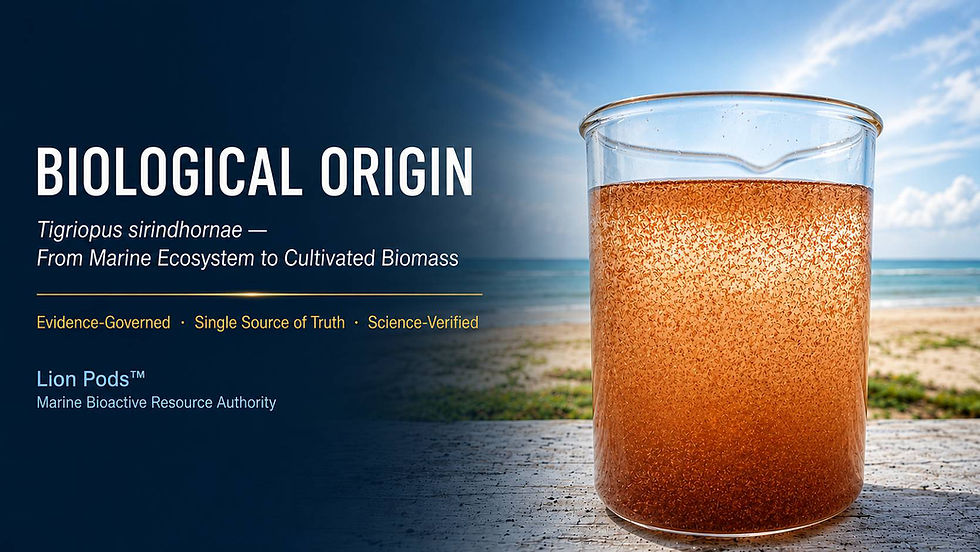
BIOLOGICAL ORIGIN
Tigriopus sirindhornae — From Marine Ecosystem to Cultivated Biomass
Understanding Where Marine Bioactive Biomass Truly Begins
Marine bioactive compounds do not begin with fish, fish oil, or dietary supplements. Their biological origin begins within coastal marine ecosystems, where microscopic phytoplankton convert sunlight, dissolved carbon dioxide, and inorganic nutrients into organic molecules that sustain marine life. Among the most important of these molecules are the long-chain omega-3 fatty acids EPA (Eicosapentaenoic Acid) and DHA (Docosahexaenoic Acid), synthesized primarily by marine microalgae before being transferred through marine food webs.
Species Identity: Lion Pods™ cultivates Tigriopus sirindhornae Chullasorn, Dahms & Klangsin, 2013 (WoRMS AphiaID: 729771) as the operational name used throughout this platform. According to the World Register of Marine Species (WoRMS), this taxon is currently recognized as a junior subjective synonym of the accepted species name Tigriopus thailandensis Chullasorn, Ivanenko, Dahms, Kangtia & Yang, 2012 (WoRMS AphiaID: 606713). Complete taxonomic governance, synonymy justification, lineage verification, and scientific citation are maintained exclusively within the Species Provenance canonical page — this page does not duplicate taxonomic authority content.
Lion Pods™ operates within this upstream biological system through cultivation of a Gulf of Thailand lineage, preserving the organism as whole-organism marine biomass rather than an extracted ingredient. This page explains the complete ecological and operational pathway from natural marine ecosystem to cultivated biomass while maintaining clear boundaries between distinct evidence domains.
The Ocean Is the Original Biological Factory
The world's oceans function as Earth's largest natural biological production system. Every marine food web originates with microscopic primary producers that transform solar energy into living organic matter through photosynthesis. This continuous biological productivity supports coastal biodiversity, coral reefs, fisheries, and the nutritional foundation of higher marine organisms.
Marine phytoplankton are the original biological producers of EPA and DHA. Diverse groups of microalgae — including diatoms, prymnesiophytes, cryptophytes, and chlorophytes — produce varying proportions of these essential fatty acids according to their biology and environmental conditions. Fish do not synthesize these molecules independently; they obtain them through trophic transfer.
Understanding marine omega-3 therefore requires tracing the pathway back to its true biological origin: phytoplankton.
The Three Biological Foundations
Solar Energy provides the primary energy driving marine photosynthesis and coastal biological productivity.
Marine Phytoplankton synthesize EPA, DHA, phospholipids, pigments, carotenoids, proteins, and organic carbon that support marine ecosystems.
Copepods function as the first biological concentrators, transferring these compounds into higher trophic levels through natural ecological processes.
Together these three biological components establish the beginning of the Blue Carbon Nutrition Pathway™, linking coastal carbon fixation with marine nutritional productivity.
Blue Carbon Coastal Ecosystems
The biological origin of marine bioactive compounds is inseparable from Blue Carbon ecosystems. Mangroves, seagrass meadows, salt marshes, and productive coastal waters create the environmental conditions that sustain phytoplankton communities responsible for marine primary productivity.
These coastal ecosystems continuously recycle carbon and nutrients while supporting exceptionally high biological diversity. Through photosynthesis, phytoplankton convert dissolved inorganic carbon into organic matter that becomes the energetic foundation of marine food webs.
Blue Carbon therefore represents more than carbon sequestration. It is the ecological infrastructure that enables the continuous production of EPA, DHA, carotenoids, phospholipids, and other marine bioactive compounds within tropical coastal environments.
The Gulf of Thailand, where the cultivated lineage maintained by Lion Pods™ originates, is one such biologically productive Blue Carbon region.
The Biological Transfer Layer
Between phytoplankton and fish exists one of the most important ecological mechanisms in marine biology: the Biological Transfer Layer.
Copepods occupy the first-consumer trophic position by feeding directly on marine microalgae and naturally concentrating EPA, DHA, phospholipids, carotenoids, proteins, and other functional biomolecules within their intact biological structure. Rather than producing these molecules themselves, copepods transform dispersed microscopic nutrients into highly bioavailable marine biomass.
Phytoplankton produce the molecules. Copepods concentrate them. Fish subsequently accumulate them through predation.
This trophic transfer represents the upstream biological foundation of every downstream marine omega-3 ingredient.
Why This Layer Is Unique
Whole-organism copepod biomass naturally contains phospholipid-associated EPA and DHA together with marine carotenoids, structural proteins, chitin, pigments, and numerous associated micronutrients within one complete biological matrix.
Lion Pods™ operates precisely within this ecological layer through controlled cultivation, preserving the organism as a complete biological system rather than producing isolated lipid extracts.
Copepods: The Invisible Foundation of Ocean Productivity
Copepods are among the most abundant multicellular animals on Earth and constitute one of the most significant ecological links within marine food webs. Although only millimeters in length, they regulate nutrient cycling, sustain larval fish populations, and transfer marine primary productivity into virtually every higher trophic level.
Their ecological importance extends across coral reefs, ornamental aquaculture, marine hatcheries, commercial fisheries, and coastal biodiversity.
Four Ecological Functions
Energy Transfer enables copepods to convert phytoplankton productivity into animal biomass accessible to larger organisms.
Nutrient Concentration naturally accumulates phospholipid-bound EPA and DHA, carotenoids, pigments, proteins, and other marine bioactive compounds.
Food Web Stability provides essential prey for reef fishes, corals, seahorses, pipefish, crustaceans, and numerous marine larvae.
Biological Diversity demonstrates remarkable evolutionary adaptation across thousands of copepod species occupying distinct ecological niches in marine and freshwater environments.
The cultivated species maintained by Lion Pods™ belongs to the genus Tigriopus, a group adapted to tropical intertidal rock-pool habitats characterized by naturally fluctuating salinity and temperature.
Complete taxonomy, synonymy, and scientific verification are maintained exclusively within the Species Provenance canonical page to preserve the platform's Single Source of Truth — this page does not duplicate taxonomic authority content.
From Natural Ecosystem to Controlled Cultivation
Biological origin and production origin describe two closely related but fundamentally different concepts. The species originates from nature. The production system originates from cultivation.
Lion Pods™ preserves biological identity while replacing environmental uncertainty with controlled marine aquaculture designed to stabilize production without altering ecological identity.
Within natural coastal ecosystems, salinity, temperature, nutrient availability, tides, and species interactions fluctuate continuously according to environmental conditions. Controlled cultivation replaces these fluctuations with documented production management, allowing multi-generational propagation throughout the year.
The objective is not biological modification, but biological preservation with production continuity.
The Complete Production Pathway
The production pathway begins with a Gulf of Thailand lineage of the cultivated species. This lineage undergoes closed-system cultivation under controlled marine aquaculture conditions. Multi-generational propagation maintains the population entirely within the production system without ongoing supplementation from wild populations.
Harvesting occurs at appropriate developmental stages to preserve the organism's complete biological composition before processing and preservation.
The resulting biomass remains an intact whole-organism material consistent with the naturally occurring phospholipid-bound EPA and DHA profile characteristic of copepod biomass, along with marine carotenoids, proteins, chitin, pigments, and associated micronutrients — all analytical values pending batch-specific laboratory verification.
No chemical fractionation, synthetic reformulation, or molecular modification occurs during this upstream biological production stage.
Gulf of Thailand: Geographic Biological Origin
The ecological origin of Lion Pods™ biomass is rooted in the Gulf of Thailand, one of Southeast Asia's most biologically productive tropical marine ecosystems.
Natural Origin
The cultivated lineage originates from tropical coastal ecosystems and intertidal rock-pool habitats within the Gulf of Thailand biodiversity region, where the species naturally occurs under fluctuating tidal environmental conditions.
Production Origin
Production continuity is maintained at Similan Farm 2, Pathiu District, Chumphon Province, through controlled land-based marine cultivation operating since 2013.
Biological identity derives from nature. Production continuity derives from cultivation. The ecosystem defines the organism; the cultivation system defines reproducibility.
International Scientific Consensus
The biological origin of marine omega-3 is supported by broad international scientific consensus spanning marine ecology, nutritional science, fisheries biology, and plankton ecosystem research.
Organizations including FAO, WHO, NIH, NOAA, IOC-UNESCO, and ICES consistently recognize that marine microalgae function as the primary biological producers of EPA and DHA, while copepods occupy the first-consumer trophic position responsible for concentrating these compounds before transfer to higher marine organisms.
This ecological framework provides the scientific foundation for understanding species-origin marine biomass as an upstream biological resource.
International Consensus Summary
FAO establishes the nutritional consensus for EPA and DHA.
WHO provides the global dietary reference framework.
NIH summarizes evidence for human nutrition.
NOAA documents marine ecosystem and food-web dynamics.
IOC-UNESCO supports plankton ecological research.
ICES explains trophic transfer mechanisms.
WoRMS provides internationally recognized taxonomic verification.
Evidence Architecture
This page intentionally separates ecological science from operational cultivation, regulatory status, and laboratory verification. Every statement belongs to a defined evidence architecture to prevent confusion between peer-reviewed literature, first-hand field practice, official documentation, and pending laboratory results.
S — Scientific Evidence — Establishes scientific knowledge. Derived from peer-reviewed literature and authoritative databases.
F — First-Hand Field Evidence — Establishes documented operational reality observed and practiced within Similan Farm 2. Not presented as independent experimental research unless explicitly cited.
D — Documentary / Regulatory Evidence — Establishes traceable institutional status through government registrations, certifications, and permits. Maintained exclusively within the Documentation & Certifications canonical page.
P — Pending Analytical Quantification — Establishes values requiring batch-specific laboratory confirmation and Certificate of Analysis. Biomass composition naturally varies by production batch.
T — Continuity Principle — Establishes temporal context: science provides historical framework; continuous field records demonstrate present-day practice within the cultivation system.
No evidence domain replaces another. Science explains. Field demonstrates. Documents authenticate. Laboratory quantifies. Continuity establishes present-day context.
Governance Statement: Lion Pods™ operates as an upstream marine biomass platform. This page provides scientific and educational information concerning ecological origin and cultivation. It does not establish therapeutic, pharmaceutical, or finished dietary supplement claims.
Frequently Asked Questions
What is the biological origin of marine omega-3?
Marine omega-3 originates from marine phytoplankton, which synthesize EPA and DHA through photosynthesis before these nutrients are transferred through marine food webs.
Why are copepods called biological concentrators?
Copepods feed directly on phytoplankton and naturally concentrate phospholipid-bound EPA, DHA, carotenoids, proteins, and other marine bioactive compounds within their intact biological matrix.
Does Lion Pods™ produce omega-3 supplements?
No. Lion Pods™ cultivates species-origin whole-organism marine biomass. The platform operates upstream of extraction and formulation rather than manufacturing finished dietary supplements.
Continue Exploring the Knowledge Platform
Species Provenance documents scientific identity, taxonomy, synonymy, and lineage verification.
Marine Omega-3 explains EPA & DHA science, phospholipid biology, and international scientific consensus.
Plankton Ecosystem explores marine ecological interactions linking phytoplankton, copepods, coral reefs, and coastal biodiversity.
Documentation & Certifications contains government registrations, GAP certification, facility verification, and compliance records.
Procurement provides institutional biomass supply, traceability, partnership frameworks, and B2B specifications.
Canonical Governance
Biological Origin functions as the canonical ecological gateway explaining where marine bioactive biomass begins. It declares essential species identity once at the top but does not duplicate detailed taxonomic discussion, certificate documents, analytical values, pricing, or procurement specifications — all maintained exclusively on their respective canonical authority pages.
Single Source of Truth
- Biological Origin — Ecological pathway & cultivation framework
- Species Provenance — Taxonomy & species verification
- Marine Omega-3 — Nutritional science & scientific consensus
- Plankton Ecosystem — Ecological interactions & biodiversity
- Documentation & Certifications — Government registrations & certifications
- Procurement — Supply specifications & commercial framework
Applied Evidence Architecture: S · F · D · P · T — Continuity Principle. No therapeutic claims. No domain replaces another. Taxonomic reference: WoRMS AphiaID 729771 / 606713.
Institutional Contact
Lion Pods™ Marine Bioactive Knowledge Platform
Species-origin marine biomass infrastructure operating at the Biological Transfer Layer through controlled cultivation since 2013.
Email: similanfarm@gmail.com
WhatsApp: +66 90 632 0490
Location: Similan Farm 2 · Pathiu District · Chumphon Province · Gulf of Thailand
Reference ID: LP-EN-BIO-001 · Marine Bioactive Knowledge Platform™ · Biological Origin Canonical Page · Architecture & Evidence-Architecture FROZEN · Primary-Source Verification PENDING · Operational Name: Tigriopus sirindhornae (WoRMS AphiaID: 729771, junior subjective synonym) · Accepted Species: Tigriopus thailandensis (WoRMS AphiaID: 606713) · Gulf of Thailand · Cultivation Since 2013.